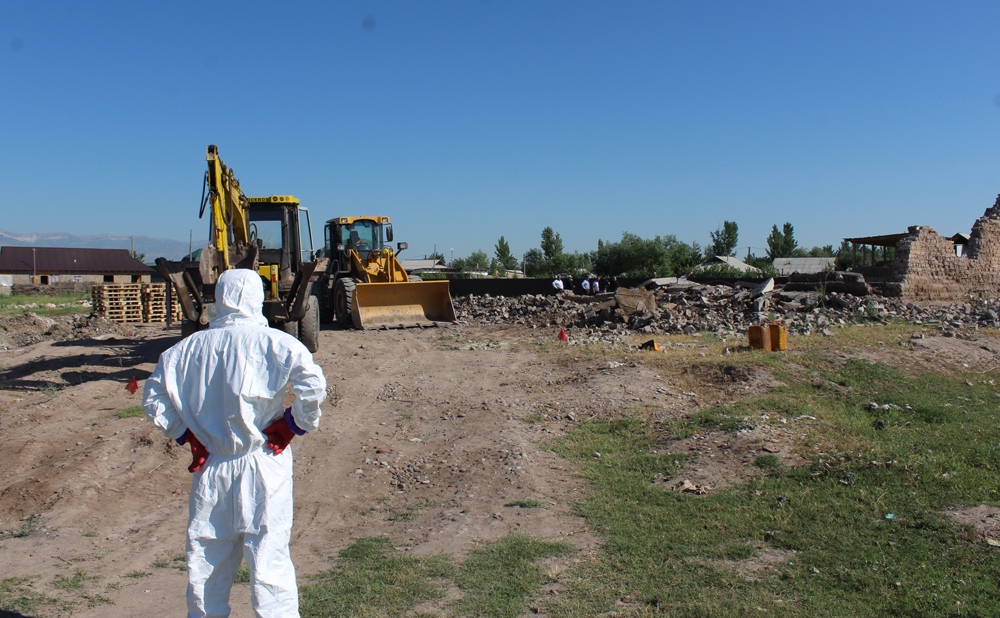
People live in the vicinity of toxic chemicals because they have no money for resettlement

The Committee for Environmental Protection has begun removal of hundred tons of toxic chemicals and contaminated soil from warehouses of former collective farmers in the Jomi district of Khatlon province.   People there live in the vicinity of the pesticide warehouses, do not realize what danger they face and continue building houses near the harmful facilities.   […]

The Committee for Environmental Protection has begun removal of hundred tons of toxic chemicals and contaminated soil from warehouses of former collective farmers in the Jomi district of Khatlon province.  

People there live in the vicinity of the pesticide warehouses, do not realize what danger they face and continue building houses near the harmful facilities.  

The process of liquidation of the contaminated materials began in the Jomi district on May 12.

Rahmatullo Khairulloyev, the head of the National Center for Fulfillment of Tajikistan’s Obligations under Stockholm Convention, says specialists from the Committee for Environmental Protection have inventoried the warehouse in which pesticides, including DDT (dichlorodiphenyltrichloroethane), have been stored since the Soviet era.  

According to Khairulloyev, their specialists have discovered eight such warehouses in the Jomi district alone.

“The examination findings show that concentration of DDT in the territory of the village of Jovidon in the Aral jamoat of the Jomi district is very high.  Therefore, we have decided to carry out the Clean Land action in this village.  We plan to remove more than 100 tons of contaminated soil and toxic chemicals to the Vakhsh toxic chemicals range,” Khairulloyev said.   

“The pesticide storage facilities that had been constructed in the Soviet era began crumbling.  Moreover, local residents are using bricks of the warehouses for their needs,” said the head of the National Center for Fulfillment of Tajikistan’s Obligations under Stockholm Convention.  “It is still impossible to demolish the warehouses themselves and remove them to the range because of lack of money.  Therefore, it has been decided to fence the facilities.”      

According to specialists, 164 warehouses storing toxic chemicals have been studied in Tajikistan.


 

Join us on social media!

Article translations:

Related Article

Оби зулол
Оби зулол
Tenisi

Most Read

Коммерсбонк Точикистон

Recent Articles

The first Afghan woman on Everest advocates for girls’ rights

She launched a campaign to support education for girls.

Female Founders Forum Tajikistan 2026 (3F Forum)

Investment, Technology, and Entrepreneurship Leaders to Converge in Dushanbe TechXhub...

A School with no room for error. Why is it difficult for Tajik children to be creative?

How the fear of making mistakes, the cult of the "right answer," and an overloaded school system affect children's initiative, creativity, and decision-making skills in adulthood.

Tajikistan again warns about the risk of mudflows

The Agency for Hydrometeorology of Tajikistan (Hydromet) reports that...

Trump demands changes to the Iran agreement draft

The President of the United States demanded changes to the already agreed-upon treaty with Iran.

Media: UN faces bankruptcy due to delayed payments from the US and China

Both Germany and the United Kingdom have reduced their support for the UN.

The two-way trade with Uzbekistan increases by more than 50%

What do our neighbors buy from us, and what do we bring from them?

Up to +45°C and rare rains: what will June be like in Tajikistan?

In most regions of Tajikistan, June will be hot and dry; however, thunderstorms with rain are possible on certain days.