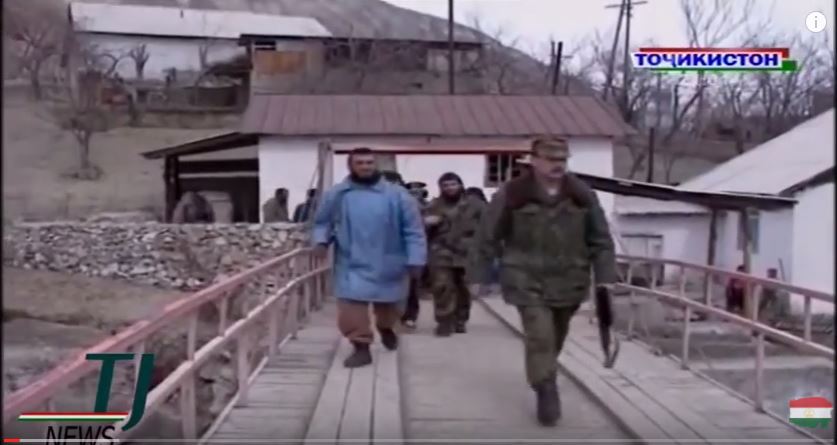
Tajik authorities have accused Iran of backing high-profile killings in Tajikistan during the Tajik civil war in the 1990s.
In a documentary broadcast on Tajik national television yesterday, the Interior Ministry claimed that Iran was allegedly interested in unleashing civil war in Tajikistan, and it allegedly provided assistance to the Islamic Revival Party of Tajikistan (IRPT) and trained its militants in Iranian territory.
According to the Interior Ministry, Iranian financial support and instructions to carry out assassinations were conveyed to IRPT militants through Abduhalim Nazarzoda, a former deputy defense minister who was one of the IRPT commanders in the 1990s. Abduhalim Nazarzoda was killed in September 2015 during an anti-coup operation in the Romit Gorge, not far from Dushanbe.
A number of Tajik public figures – ex-chairman of the Tajik parliament Safarali Kenjayev, Professor Mohammad Osimi, Dr. Yusuf Ishoqi, novelist Saif Afardi, presidential political adviser Karim Yuldoshev, the former Grand Mufti of Tajikistan Fathullokhon — and 20 Russian officers were assassinated between 1997 and 2004. According to the Interior Ministry, they were allegedly assassinated by order of Abduhalim Nazarzoda under financial support of Tehran.
A man who introduced himself as a former Islamic party fighter in the documentary said that he traveled to Iran in 1995 and received sabotage training along with 200 compatriots in the city of Qom. He said he returned to Tajikistan in 1997 with clear instructions to kill political and public figures.
The detained supporters of Nazarzoda – Taghoymurod Ashrapov, Abduqodir Abdulloyev and Saymuhriddin Qudratov – said that they had been trained in camps located in the Iranian cities of Qum, Mashhad, Tehran and Gorgan.
Ashrapov claimed that for killing Safarali Kenjayev in 1999 they had received 2,000 U.S. dollars each from Abduhalim Nazarzoda.
According to him, the main purpose of assassination of Tajik public figures was to incite hatred against the country’s government.
Meanwhile, Iran and Russia acted as mediators in the Tajik negotiation process which ended the five-year civil war in 1997.
According to some experts, the documentary aired amid tensions between Tajikistan and Iran over Tehran's support for the Islamic Revival Party of Tajikistan, which the Supreme Court of Tajikistan has declared a terrorist group.
Tajikistan and Iran have traditionally close relations, sharing many similar cultural, religious and ethnic identifiers and Iran has been a major sponsor of essential hydropower infrastructure in Tajikistan, but Iran has angered Tajikistan by welcoming IRPT leader Muhiddin Kabiri, who is wanted by police in Tajikistan to face various terrorism charges.
Recall, Iran invited IRPT leader Muhiddin Kabiri to attend the International Islamic Unity Conference that took place in Tehran on December 27-29, 2015.
Tajikistan’s MFA said in a statement on December 29 that it was “greatly concerned” that “the head of the extremist and terrorist former IRPT, Muhiddin Kabiri, who faces charges of attempting to overthrow the government … has been invited to the conference.”
In early July this year, the Iranian trade and culture center in the Tajik northern city of Khujand, which was particularly appreciated for its library services and fast internet, closed its doors. The shuttering reportedly came at the request of the Tajik authorities.