Tajikistan will receive 230 million U.S. dollars in a form of grant and 79 million U.S. dollars in a form of preferential loan from China. These are the main results of the recent state visit of Tajik President Emomali Rahmon to China.
In the framework of a government-to-government agreement on technical and economic cooperation on providing no strings aid that was signed between Tajikistan and China in Beijing on September 1, China will provide Tajikistan with USD 230 million to build a new parliamentary complex, a source in the Tajik government told Asia-Plus in an interview.
Besides, China will provide Tajikistan with a preferential loan of USD 79 million for construction of a 500 kV power transmission line in districts subordinate to the center.
Many Tajik experts consider that the recent state visit of President Emomali Rahmon to China was fruitful, while some others consider that China’s decision to allocate a US$230 million grant for construction of a new Tajik parliamentary complex is the next step by Beijing to bolster its influence in the country.
Recall, the new parliamentary complex of Tajikistan will be built on the premises of the Ministry of Agriculture of Tajikistan, the Mayor’s Office of Dushanbe, the Embassy of Iran and several residential buildings. This will be located on an area of 6 hectares from the intersection of Tehran Street and Roudaki Avenue (Dousti Square) to the intersection of Roudaki Avenue and Shirinsho Shotemur Street (the area of Tajikistan Hotel).
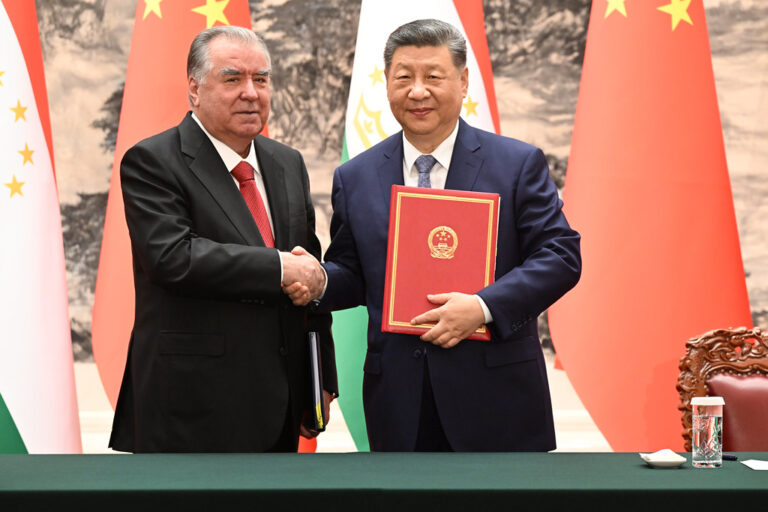
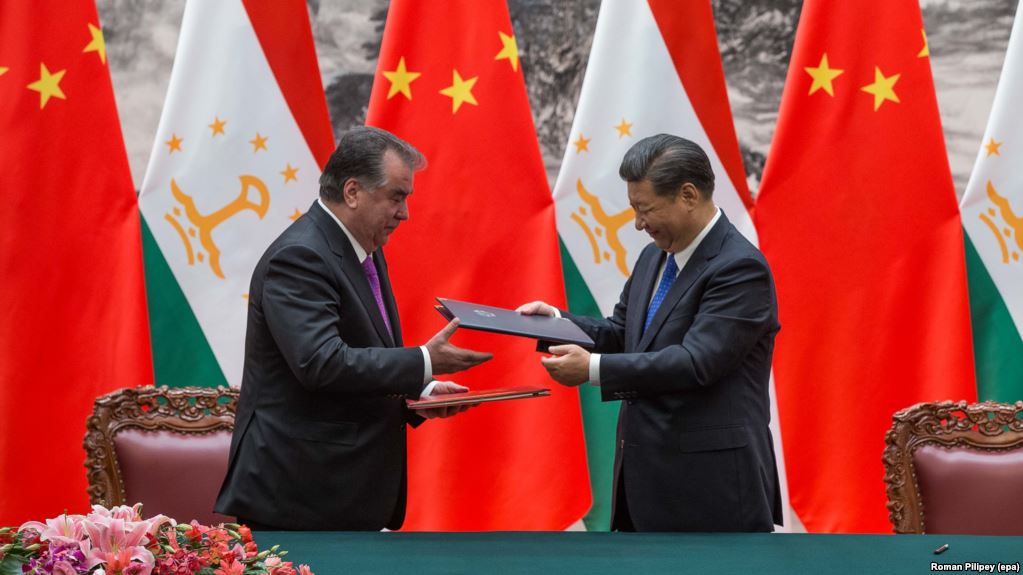
Tajik President Emomai Rahmon and his Chinese counterpart Xi Jinping, during their talks in Beijing on August 31, reportedly agreed to establish comprehensive strategic partnership between the two countries to push the China-Tajikistan cooperation to a new historical point.
Describing the mutual political trust and mutually beneficial cooperation between China and Tajikistan as an unprecedented level, Rahmon said the talks with Xi have deepened bilateral relationship and expanded partnership in finance, agriculture, water resources, energy, science park and transportation connectivity, among other fields.
After the talks, the two heads of state signed a joint statement on establishing comprehensive strategic partnership.
China and Tajikistan agreed to jointly launch cross-border railway, road and natural gas pipeline projects, and explore cooperation in wind and solar energy, according to the joint statement.
Both sides will better share intelligence to fight the “evil forces” of terrorism, extremism and separatism, as well as cybercrime, drug smuggling and transnational organized crime, the joint statement said.
Tajikistan follows the one-China policy, opposes any form of Taiwan independence and supports the Chinese government's effort to achieve national reunification, it said.
Rahmon and Xi also witnessed the signing of a series of cooperation documents, including a bilateral cooperation plan, and agreements on science, agriculture, energy, infrastructure, human resources and media.
China is a vital source of investments in Tajikistan’s economy, which is also strongly dependent on remittances sent home by migrant workers in Russia. For the most part, Chinese economic assistance to Tajikistan has targeted key infrastructure projects including roads and railways linking the republic’s north and south.
Beijing now owns some $1.2 billion of Tajikistan’s total external debt of $2.3 billion, a share equal to around a sixth of the country’s gross domestic product (GDP).