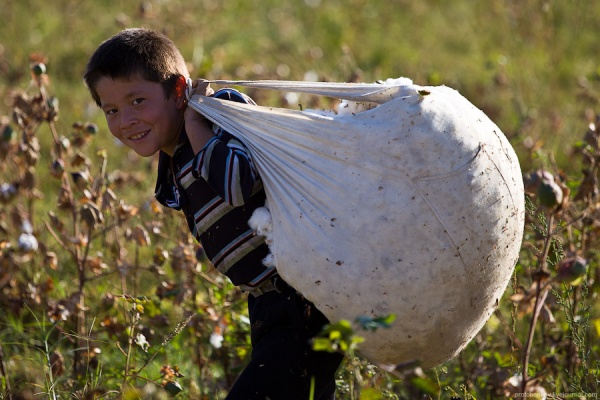
International Labor Rights Forum (ILRF) calls for pressure on Uzbekistan to end forced cotton labor.
A letter released by ILRF, in particular, notes that the Uzbek authorities operate one of the world’s largest state-run systems of forced labor.
“An estimated one million citizens each year are coerced under threat of penalty to harvest cotton for a state-run enterprise that benefits only the government elite,” says the letter. “Civil society monitors who report on the conditions of the harvest are routinely detained, harassed and physically assaulted, while journalists who attempt to document the truth are detained and deported.”
“International actors, including the World Bank and its private sector lending arm the International Finance Corporation, are putting funds into this trade in dirty cotton. The World Bank Group is an international institution that provides loans for developing countries. Right now it is providing almost $500 million to Uzbek agriculture projects, including for cotton. The World Bank signed a contract agreeing to suspend certain loans if evidence of forced labor was uncovered, yet despite two years of documented proof showing forced labor continues on World Bank project sites, particularly in the poor and vulnerable region of Karakalpakstan, the World Bank has yet to suspend its loans.”
Meanwhile, according to the Cotton Campaign, Uzbekistan is one of the world’s largest cotton exporters, and the government of Uzbekistan uses one of the largest state-orchestrated systems of forced labor to produce it.
Every year the government of Uzbekistan forcibly mobilizes over a million citizens to grow and harvest cotton. The Uzbek government forces farmers to grow cotton and deliver production quotas under threats of penalty, including the loss of the lease to farm the land, criminal charges and fines. The government forces over a million citizens to pick cotton and deliver harvest quotas under threat of penalty, including expulsion from school, job loss, and loss of social security benefits.
Forced labor and child labor in the cotton sector of Uzbekistan is unique to the world: it is a state-controlled system, under the direction of a president in power since the end of the Soviet Union, which violates the fundamental rights of millions of Uzbek citizens each year.
Cotton picking is dangerous work. Each year, the forced-labor system of cotton production has reportedly claimed the lives of several Uzbek citizens, and many forced to pick cotton are exposed to unknown chemicals in the fields, unsanitary housing, and lack of safe drinking water.
In 2015 and 2016, the government of Uzbekistan reportedly forced more than a million people, including students, teachers, doctors, nurses, and employees of government agencies and private businesses to the cotton fields, against their will and under threat of penalty, especially losing their jobs.
The Uzbek-government forced labor system violates the human rights of Uzbek citizens and condemns future generations to a cycle of poverty. The practice violates Uzbek labor laws and fundamental international labor and human rights conventions ratified by the Uzbek government, including the International Labour Organization Abolition of Forced Labour Convention (No. 105), International Convention on Civil and Political Rights (Article 8), the Protocol to Prevent, Suppress and Punish Trafficking in Persons (supplementing the United Nations Convention against Transnational Organized Crime and also known as the “Palermo Protocol”), and the Universal Declaration of Human Rights (Article 23).
The Cotton Campaign is a global coalition of human rights, labor, responsible investor and business organizations dedicated to eradicating child and forced labor in cotton production.