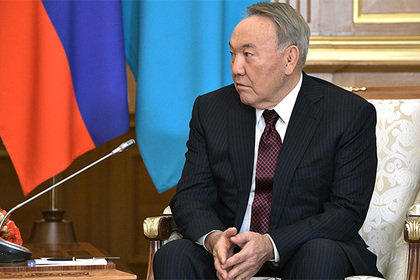
Kazakhstan’s President Nursultan Nazarbayev has signed an executive order on Friday telling his government to prepare the Kazakh alphabet for a transition to Latin letters from Cyrillic ones by 2025.
"The government of Kazakhstan is to set up a national commission to change the Kazakh alphabet to Latin script; organize a gradual switch to Latin script by 2025," the document circulated to state media read.
Recall, President Nazarbayev authored an article, on April 12, in the state-run newspaper Egemen Kazakhstan (Independent Kazakhstan) under the title “Looking into the Future: Modernization of Public Conscience.” In his article, the president, in particular, suggested changing the current Kazakh alphabet from Cyrillic to Latin. The whole process, he declares, needs to be finalized by 2025.
A special commission was set up on April 13 to working on creating “the most appropriate” variant of the Latin-based script for the Kazakh language.”
Meanwhile, some experts consider that the move is seen as an effort to emphasize Kazakh culture and distance the country from Russia.
The Latin alphabet was used in Kazakhstan between 1929 and 1940, when Soviet authorities decided it was time to switch back to Cyrillic. In fact, a special, so-called “missionary” version of Cyrillic had been developed in the 19th century by learned Russian immigrants settled in Kazakh lands as part of the geographic expansion of the Russian Empire into Central Asia. A prominent Kazakh educator, Ybray Altynsarin, had greatly contributed to the mass introduction of Cyrillic among native Kazakh speakers. It was in use until the October Revolution of 1917. Prior to that, Kazakhs had been using a 29-character Arabic script with a few modifications to reflect phonetic specificities. Written Arabic had been present throughout Kazakhstan since the tenth century. Tengrinews.kz reported on April 14 that for Nazarbayev, the 1940 decision to return to Cyrillic was purely “political” and did not reflect the cultural reality of Kazakhstan nor its linguistic history.