
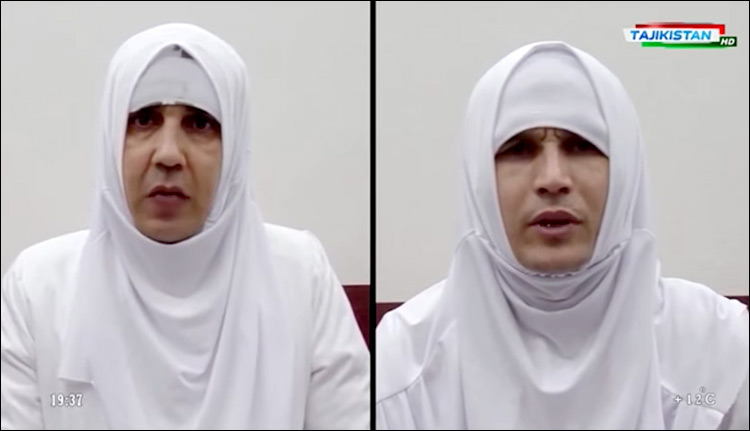
Two men from Khatlon’s Shahritous district, who were wanted by police for recruiting citizens of Tajikistan into terrorist organizations, were dressing up as women and wearing a hijab in order to avoid police, according to the Interior Ministry press center.
The 33-year-old Akmal Safarov and the 35-year-old Alisher Nuraliyev had reportedly managed to hide from police for a long time.
They had been dressing up as women and wearing a hijab and freely appearing in public places.
Criminal proceedings were instituted against them under the provisions of two articles of Tajikistan’s Penal Code: Article 32 – preparation for crime and criminal attempt; and Article 401 – mercenary activities; an investigation is under way.
The detainees reportedly confessed that they joined the Salafi Group in 2015, established contracts with representatives of terrorist organizations fighting in foreign countries, and were going to join them in the near future.
The Salafi movement or Salafist movement is an ultra-conservative orthodox movement within Sunni Islam that references the doctrine known as Salafism. The movement first appeared in Tajikistan in the early 2000s, having been brought back to the country by Tajiks that had taken refuge in Pakistan during the civil war.
The movement claims to follow a strict and pure form of Islam, but Tajik clerics say the Salafists’ radical stance is similar to that of the Taliban in Afghanistan.
Salafists do not recognize other branches of Islam, such as Shi'a and Sufism. The movement is frequently referred to as Wahhabism, although Salafists reject this as derogatory.
The Tajik authorities banned Salafism as an illegal group on January 8, 2009, saying the Salafi movement represents a potential threat to national security and the Supreme Court added Salafis to its list of religious groups prohibited from operating in the country.
On December 8, 2014, the Supreme Court of Tajikistan formally labeled the banned Salafi group as an extremist organization. The ruling reportedly followed a request submitted to the court by the Prosecutor-General’s Office. The ruling means that the group’s website and printed materials are also banned.
The overwhelming majority of Tajiks are followers of the Hanafi madhab, a more liberal branch of Sunni Islam.