Community-Based Savings Programme in Tajikistan

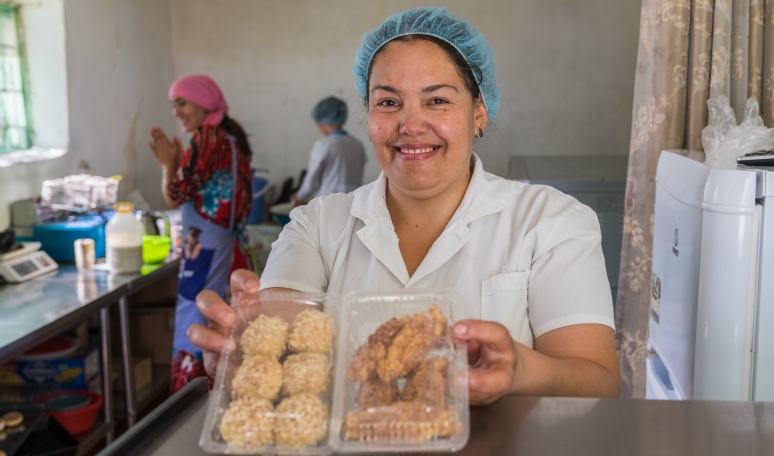
“My main aim is to provide fresh baked products to children, and use imports less,” says Gulniso, a member of one of the 2,600 Community Based Savings Groups (CBSGs) the Aga Foundation has helped establish in Tajikistan to support marginalized women to save money and take out small loans. The Aga Khan Development Network (AKDN) […]

Asia-Plus

“My main aim is to provide fresh baked products to children, and use imports less,” says Gulniso, a member of one of the 2,600 Community Based Savings Groups (CBSGs) the Aga Foundation has helped establish in Tajikistan to support marginalized women to save money and take out small loans.

The Aga Khan Development Network (AKDN) notes that thanks to her CBSG and a grant from USAID – US Agency for International Development, Gulniso was able to buy an oven, ingredients and other machinery for her bakery.  She now employs six staff and produces an assortment of cakes and pastries for weddings, birthdays, and everyday occasions.

The Aga Khan Foundation (AKF) established the Community-Based Savings Programme (CBSG) in 2009 to promote community-managed financial services in the disadvantaged communities where it works.  This built on decades of experience with community-managed microfinance approaches, but offered a less cost-intensive approach.  CBSGs respond directly to the financial service needs of the remote and rural poor by providing a secure, convenient place to save and take small loans on flexible terms.  The CBSG savings opportunity is particularly well suited to the remote rural poor.

CBSGs are self-managed groups of 15-25 people and systems are kept simple and transparent to promote independence from AKF, and maintain transparency for members.  There are more than 400,000 AKF CBSG members, of which 73% were women, saving more than 13 million US dollars per year.

Join us on social media!

Article translations:

Related Article

Оби зулол
Оби зулол

Most Read

Акика Алиф

Recent Articles

Climate risks threaten food security in Central Asia – FAO

Land degradation reduces agricultural productivity. The loss of biodiversity weakens the ecosystems that farmers, livestock breeders, and rural communities depend on.

Potential or illusion? Why the world overlooks Tajikistan’s mineral wealth

The republic may indeed possess significant reserves of rare metals, but there is a catch...

The case of ousted Kyrgyz security boss classified and moves to court

The former head of the GKNB is charged with violent seizure of power and abuse of official position.

Trump states that Iran’s nuclear program is a higher priority than U.S. citizens’ economic issues

Fluctuations in energy prices led to record inflation in the United States in April, the highest in the past three years.

Foot-and-mouth disease, plague, and flu: Central Asia threatened by transboundary animal diseases

FAO urges Central Asian countries to strengthen coordination and epidemiological surveillance.

Tajikistan approves the second phase of the Electric Transport Development Program; $95 million will be allocated for its implementation.

At this stage, the authorities are focusing on charging infrastructure, services for electric vehicles, and the expansion of the electric bus fleet.

Tajikistan and Kazakhstan to sign roadmap for cooperation in the agrarian sector

The parties are interested in expanding investment cooperation and establishing joint ventures.

Emomali Rahmon awarded honorary professorship by Peking University

Tajik President Emomali Rahmon has been awarded an honorary...

Belgian authorities review the results of tax reforms in Tajikistan

Negotiations took place in Brussels between the head of the Tax Committee of the Republic of Tatarstan and the leadership of the Federal Public Service Finance of Belgium.