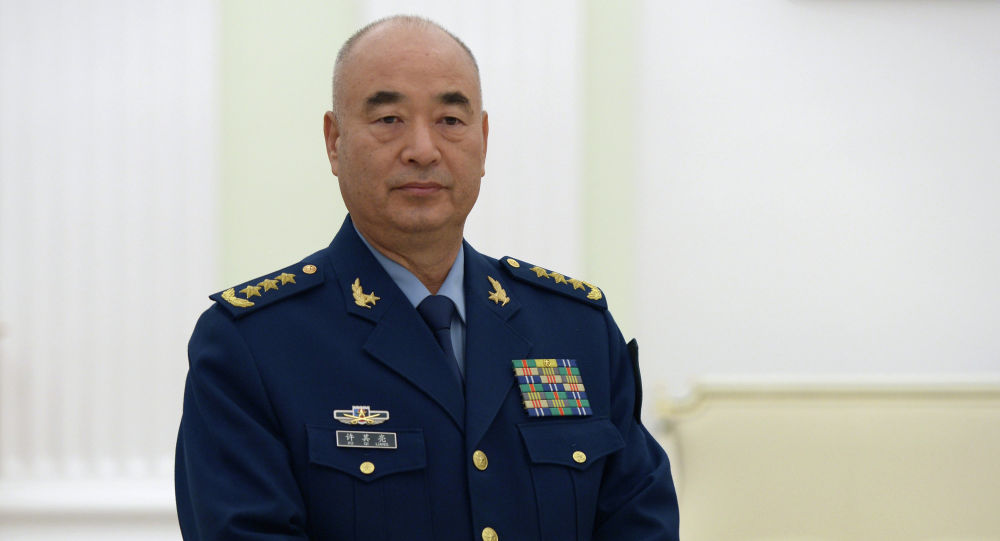
Vice Chairman of the Communist Party of China (CPC) Central Military Commission and the Central Military Commission of the People's Republic of China (PRC), Colonel-General Xu Qiliang, is expected to arrive in Dushanbe tomorrow on a three-day visit,
According to the Tajik MFA information department, his visit is being held in the frameworks of implementation of important agreements reached between Tajik President Emomali Rahmon and China’s leader Xi Jinping.
While in Dushanbe, Xu will hold talks with President Emomali Rahmon and Defense Minister Sherali Mirzo as well as visit one of sub units of the Ministry of Defense (MoD) of Tajikistan, an official source at a MoD told Asia-Plus in an interview.
The visit is reportedly aimed at strengthening strategic mutual understanding between Beijing and Dushanbe through expanding pragmatic military cooperation between the two countries, the source added.
Xu Qiliang was born in March 1950. He joined the People's Liberation Army (PLA) in July 1966 and the Communist Party of China (CPC) in July 1967. He graduated from the PLA Air Force's Fifth Aviation School. In 1985, he became chief of staff at the Air Force Shanghai headquarters, and also entered the PLA National Defense University for training. He was promoted to corps commander of the PLA Air Force in 1991 and was made a major general. In 1993, he became vice chief of staff of the Air Force and studied at the National Defense University again. After graduation, he was promoted to chief of staff of the PLA Air Force. He was made a lieutenant general in 1996.
In 1999, Xu became the vice commander and Air Force commander of the Shenyang Military Region, and studied at the National Defense University for the 3rd time in 2001. He was elevated to vice chief of staff of the PLA General Staff Department. He was made a full general on June 20, 2007, and became the commander of the PLA Air Force in September of that year. In October 2012, he was China's first career air force officer promoted to Vice Chairman of the Central Military Commission.
He is also a member of the 19th Politburo of the Communist Party of China. He has been an alternate member of the 14th and 15th Central Committees of the Communist Party of China, and a full member of the 16th, 17th, and 18th Central Committees.
The Central Military Commission (CMC) refers to the parallel national defense organizations of the Communist Party of China and the People's Republic of China: the Central Military Commission of the Communist Party of China, a Party organ under the CPC Central Committee, and the Central Military Commission of the People's Republic of China, a central state organ under the National People's Congress, being the military branch of the national government.
The command and control of the People's Liberation Army, the People's Armed Police and the Militia is exercised in name by the State CMC, supervised by the Standing Committee of the National People's Congress. The State CMC is nominally considered the supreme military policy-making body and its chairman, elected by the National People's Congress, is the commander-in-chief of the armed forces. In reality, command and control of the PLA, however, still resides with the Central Military Commission of the Chinese Communist Party Central Committee—the Party CMC.
Both commissions are identical in membership, thus actually forming one identical institution under two different names in order to fit in both state government and party systems. Both commissions are currently chaired by Xi Jinping, who is the General Secretary of the Communist Party of China as well as Paramount leader. The 11-man commission issues directives relating to the PLA, including senior appointments, troop deployments and arms spending. Almost all the members are senior generals, but the most important posts have always been held by the party's most senior leaders to ensure absolute loyalty of the armed forces and to ensure the survival of the regime. CMC has control over 6.8 million personnel.
The CMC is housed in the Ministry of National Defense compound ("August 1st Building") in western Beijing.