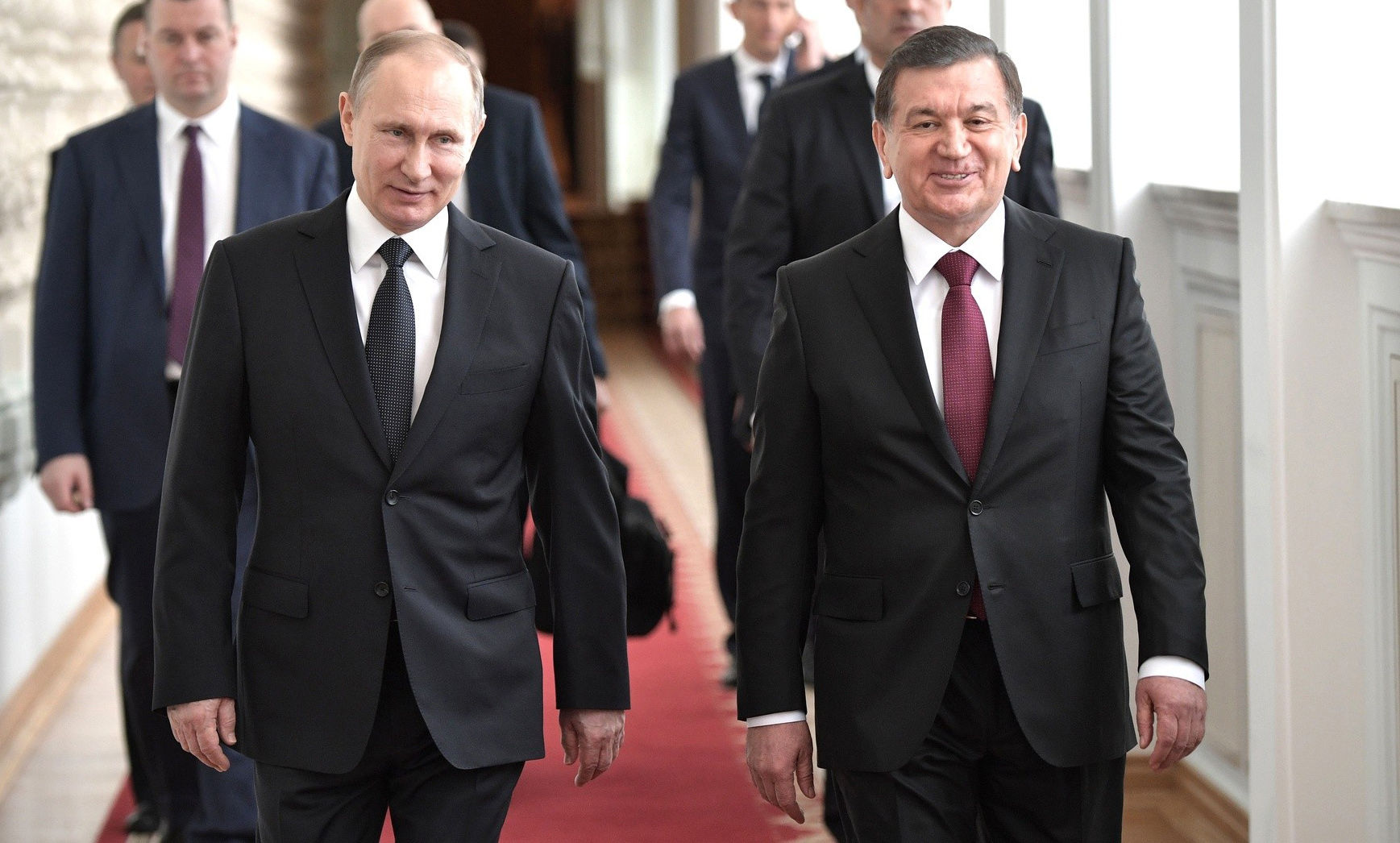
Russian President Vladimir Putin/s two-day state visit to Uzbekistan begins on October 18. Eurasianet says the expected headline takeaway from his stay will be the signing of $20 billion worth of commercial contracts.
Some observers note that incumbent Uzbek President Shavkat Mirziyoyev is cultivating equally warm ties with all and sundry in his ongoing mission to pull his nation out of its long-standing isolation.
One area of notable cooperation between Uzbekistan and Russia is defense. Ahead of Putin’s visit, Russian Defense Minister, Sergei Shoigu, was accompanied to Tashkent last week by a large military delegation. He came away with an agreement on the mutual access to one another’s airspace by military aircraft. Shoigu said this was needed “to jointly confront challenges and threats, especially the spread of international terrorism in the region.
Last April, an agreement was signed between Russia and Uzbekistan on expanding military-technical cooperation, which envisions the mutual supply of military wares, the maintenance and repair of weapons and military equipment, and assistance in research and development.
Uzbekistan has reportedly also recently resumed sending military personnel to be trained at army colleges in Russia – an arrangement that was ended in 2012. This year, 340 Uzbek officers enrolled at the colleges, according to Eurasianet.
And Russia has reportedly been supplying weapons to Uzbekistan at reduced prices since 2016. Uzbekistan is the only non-member of the Moscow-led Collective Security Treaty Organization, or CSTO, to enjoy that privilege.
This has some suspecting that Uzbekistan may break from form and begin to show interest in Moscow-led bodies.
“I would not rule out the possibility of efforts being made to draw Uzbekistan into the CSTO and the Eurasian Economic Union. It seems that Mirziyoyev is shifting from the position occupied by Karimov, who distanced his country from these organizations,” political analyst Alisher Ilkhamov told Eurasianet.
Perhaps the most significant development to occur this week will be the start of a project to build an $11 billion atomic power plant. Putin and Mirziyoyev will travel to the construction site near Tudakul lake, just east of Bukhara, on October 19.
The deal underpinning the project, which is being jointly executed with Russian state-run nuclear power company Rosatom, was signed in Moscow in September. The 2.4-gigawatt power station is slated to come online in 2028.
Another large Russian project will entail resuming the construction of an astronomical observatory on the Suffa plateau, a high-altitude spot around four hours’ drive south of Tashkent. It is believed the observatory, begun in late-Soviet times and then discontinued, will house the world’s largest radio telescope. The signing of a roadmap on this undertaking is on the agenda during Putin’s visit.
Mirziyoyev has reportedly focused much of his diplomacy with Russia on easing work-registration requirements for Uzbeks. His government is coordinating more closely with Russia’s Federal Migration Service and has opened several new consulates to better assist expatriates.
The payoff has been impressive. In 2017, labor migrants from Uzbekistan reportedly transferred $3.9 billion from Russia to their homeland. That was 42 percent more than the year before.
Mirziyoyev wants to see other areas of the economy benefit from this cordiality too. The goal is for trade turnover to hit $5 billion this year. Already in the first seven months of 2018, trade turnover increased by 32 percent compared with the same period in 2017. Russia's share of foreign trade with Uzbekistan stands at 18 percent. That is a lot, but Russia is nonetheless second to China, and that’s an important distinction.