Peacekeeping troops with the Russian-led Collective Security Treaty Organization (CSTO) began withdrawing from Kazakhstan on January 13 just as the government lifted its state of emergency in several regions. A ceremony to mark the pullout was held in the business capital, Almaty, which saw the worst of early January’s unrest.
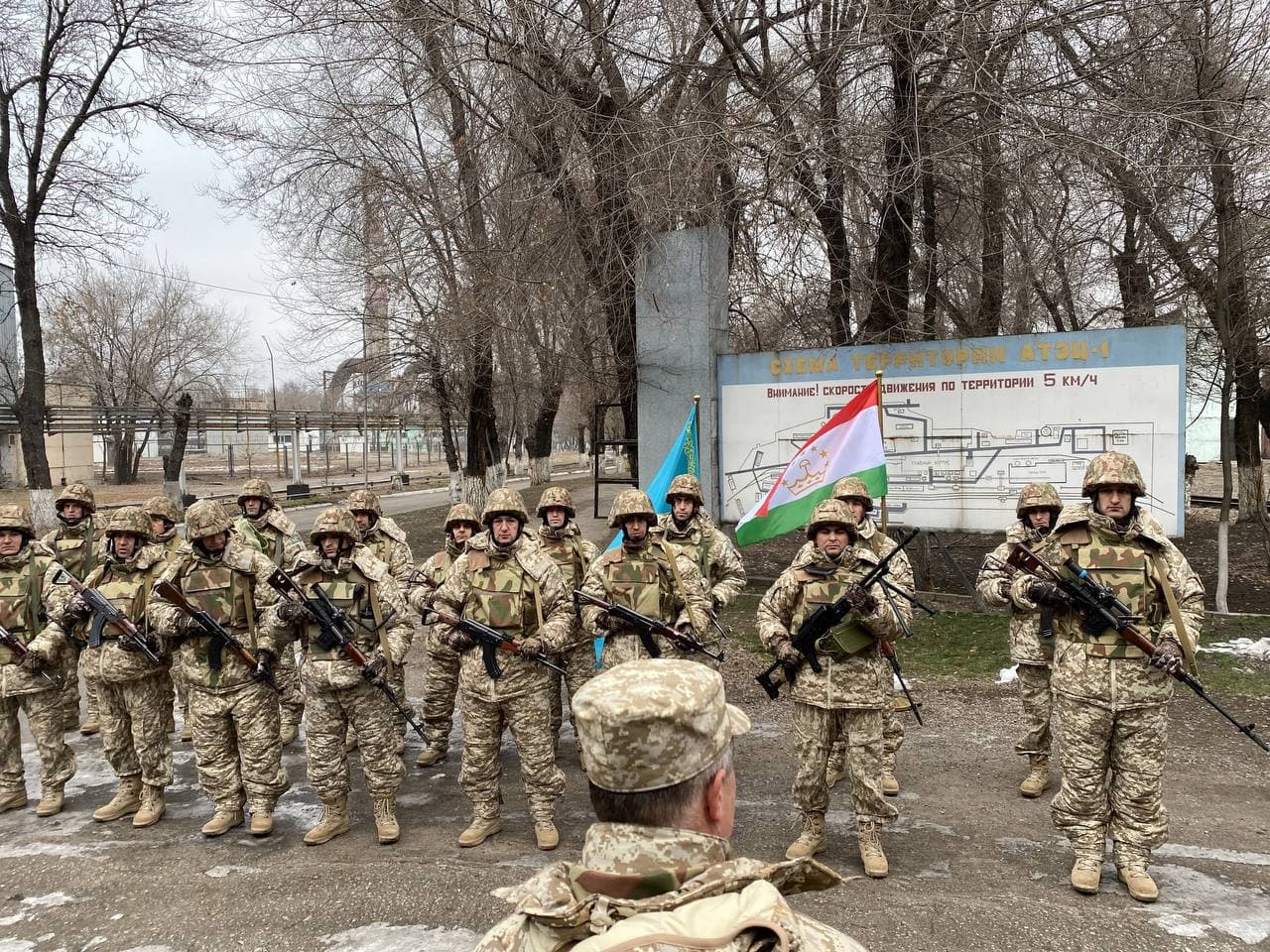
Tajik state-run news agency Khovar says Tajik peacekeepers withdrew from Kazakhstan Friday morning.
31 Tajik cadets studying at the Almaty-based Military Institute of the Kazakh Ground Forces reportedly returned to Tajikistan together with them for the winter break.
Citing Russian news agency TASS, Khovar says peacekeepers from Tajikistan, Armenia, Belarus and Kyrgyzstan left Kazakhstan Friday morning and went to places of their permanent deployment.
Tajik peacekeepers reportedly flew from Almaty to Dushanbe by IL-76 of Russia’s Air Force. They guarded the oil storage in Almaty.
Armenian peacekeepers and their vehicles were carried to Armenia by three transport planes IL-76 of Russia’s Air Force. They also took off from Almaty airport.
Belarusian peacekeepers reportedly flew by ten IL-76s of Russia’s Air Force to Minsk oblast from Zhitygen airport.
Kyrgyz peacekeepers, who were guarding a thermal power plant in Almaty left Kazakhstan in their vehicles.
Meanwhile, a part of Russian peacekeepers reportedly withdrew from Kazakhstan Thursday evening.
As it had been reported earlier, Kazakh President Kassym-Jomart Tokayev on January 5 appealed to the CSTO for assistance dealing with what he called a “terrorist threat” and the CSTO agreed to send peacekeepers the first time in the organization’s 30-year history.
The CSTO began deploying its peacekeepers in Kazakhstan on January 6 to guard strategic facilities in the country.
Article 4 of the Collective Security Treaty states that: “In the case of aggression (an armed attack threatening safety, stability, territorial integrity and sovereignty) against any Member States, all other Member States at request of this Member State shall immediately provide the latter with the necessary aid, including military.”
The deployment of the CSTO contingent saw foreign troops, mostly from Russia, but also from Belarus, Armenia, Kyrgyzstan and Tajikistan, guarding strategic facilities, such as key government buildings, airports and military warehouses, while Kazakh troops engaged in what has been dubbed an anti-terrorist operation. Fully 250 units of military machinery were flow into Kazakhstan with the roughly 2,000 CSTO peacekeepers, Eurasianet said on January 13.
This is the first time that the CSTO has agreed to deploy military forces to support an ally. It has refused requests on at least two other occasions: from Kyrgyzstan, during massive ethnic unrest in 2010; and from Armenia in 2021, as Azerbaijan pushed its post-war advantage by carrying out military incursions into Armenian territory.
In all, 200 Tajikistan’s peacekeepers were sent to Kazakhstan on the evening of January 7 after the parliament endorsed the sending of peacekeepers to Kazakhstan.
A joint meeting of both chamber of the parliament took place the same day. Parliamentarians discussed only one issue — the sending of troops to Kazakhstan as part of the CSTO peacekeeping mission. They reportedly unanimously voted for sending Tajik peacekeepers to Kazakhstan.
It is to be noted that CSTO members agreed to a major expansion of the organization to create a CSTO peacekeeping force, which could be deployed under a U.N. mandate or without one in its member states, on October 6, 2007.
On December 10, 2010, the member states approved a declaration establishing a CSTO peacekeeping force and a declaration of the CSTO member states, in addition to signing a package of joint documents.
Created in 1992, the Collective Security Treaty Organization is a Russia-led military alliance grouping the six former Soviet republics of Armenia, Belarus, Kazakhstan, Kyrgyzstan, Russia and Tajikistan.