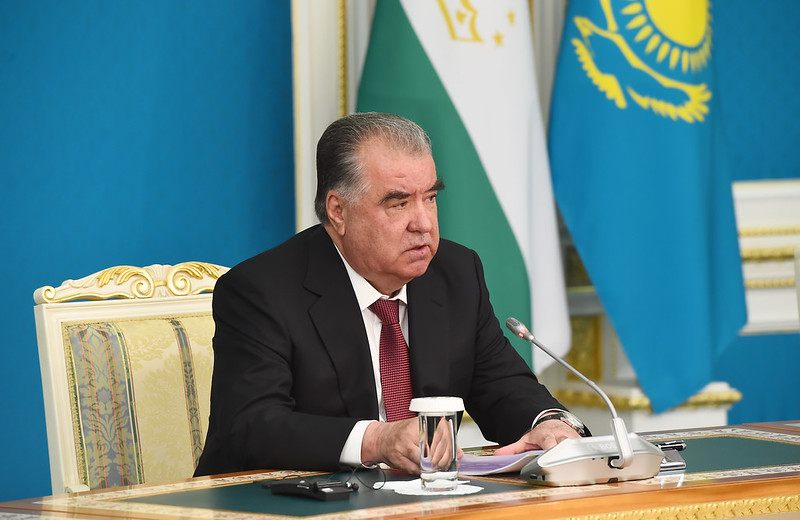
A regular meeting of the Council of Heads of Founding States of the International Fund for Saving the Aral Sea (IFAS) took place in Dushanbe on September 15.
Presidents of Tajikistan (Emomali Rahmon), Kazakhstan (Kassym-Jomart Tokayev), Turkmenistan (Serdar Berdimuhamedow) and Uzbekistan (Shavkat Mirziyoyev) participated in the meeting.
Kyrgyzstan was represented by First Deputy Prime Minister Adylbek Kasymaliyev
Speaking at the meeting, Tajik President Emomali Rahmon noted that the countries of the region must intensify coordination of their activities in water-and-energy sphere in order to address challenges and threats.
“Shallowness, drought, mudslides and landslides that we have already been seeing for several years in a row have a negative impact not only on agriculture, but also on the social situation as a whole. It is clear that we need to strengthen our cooperation and coordination, first of all cooperation in the water-and-energy sphere, in order to address these challenges and threats,” the president said.
According to him, there is already the interstate commission for water cooperation within the International Fund for Saving the Aral Sea, but there is a platform for regulation of energy issues.
“Last year at the summit in Cholpon-Ata, we instructed to hold a meeting of energy ministers to resolve such issues. It is gratifying that in the process of reform of the IFAS the energy issues have been included in the Fund mandate and it is proposed to create a separate commission on energy issues within its framework,” Emomali Rahmon noted.
He expressed confidence that this platform will be very useful for ensuring interaction between countries of the region to resolve the pressing energy issues.
“This is very important in terms of regulating water and energy issues within the framework of one institution since they are strongly interconnected in our region. More coordinated actions modernization of relevant infrastructure are needed to ensure rational and effective manage needs. We need to join efforts in this direction,” Rahmon said.
He further noted that “Tajikistan, as the rotating chair of the IFAS, has takeт a constructive approach to improving the IFAS organizational structure and legal framework.
“Our approach is to understand that the organization must correspond to current realities, be able to withstand new challenges and threats, as well as fully meet the interests of the founding states,” Rahmon added.
It was announced that Kazakhstan will assume the rotating IFAS chairmanship on January 1, 2024 and Astana will host the next meeting of the IFAS Council of Heads of Founding States.
The International Fund for Saving the Aral Sea (IFAS) was developed on March 23, 1993, by the ICWC to raise funds for the projects under Aral Sea Basin programs. The IFAS was meant to finance programs to save the sea and improve on environmental issues associated with the basin's drying.
The Aral Sea was an endorheic lake lying between Kazakhstan to its north and Uzbekistan to its south, which began shrinking in the 1960s and largely dried up by the 2010s. It was in the Aktobe and Kyzylorda regions of Kazakhstan and the Karakalpakstan autonomous region of Uzbekistan. The Aral Sea drainage basin encompasses Uzbekistan and parts of Afghanistan, Iran, Kazakhstan, Kyrgyzstan, Tajikistan, and Turkmenistan.
Formerly the fourth-largest lake in the world with an area of 68,000 square kilometers, the Aral Sea began shrinking in the 1960s after the rivers that fed it were diverted by Soviet irrigation projects. By 2007, it had declined to 10% of its original size, splitting into four lakes: the North Aral Sea; the eastern and western basins of the once far larger South Aral Sea; and the smaller intermediate Barsakelmes Lake. By 2009, the southeastern lake had disappeared and the southwestern lake had retreated to a thin strip at the western edge of the former southern sea. In subsequent years occasional water flows have led to the southeastern lake sometimes being replenished to a small degree. Satellite images by NASA in August 2014 revealed that for the first time in modern history the eastern basin of the Aral Sea had completely dried up. The eastern basin is now called the Aralkum Desert.