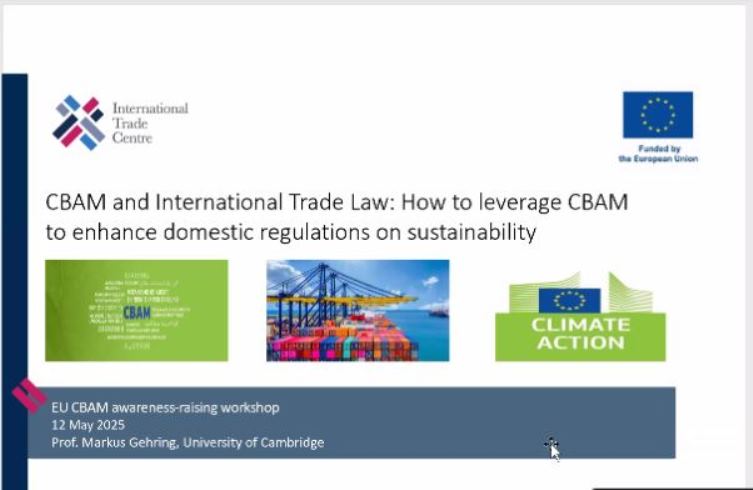
The International Trade Centre (ITC) in collaboration with the Ministry of Economic Development and Trade of Tajikistan yesterday hosted the country’s first awareness-raising event on the European Union’s (EU)’s Carbon Border Adjustment Mechanism (CBAM).
The event was organized in the framework of the project, Ready4Trade Central Asia: Fostering Prosperity through the Trans-Caspian Transport Corridor, funded by the EU and implemented by ITC in close collaboration with national partners.
The virtual event reportedly brought together policymakers and businesses to discuss how CBAM will influence international trade and why it matters for Tajikistan’s economy.
The Carbon Border Adjustment Mechanism is a new climate policy adopted by the EU to reduce global greenhouse gas emissions and promote fair competition in international markets. Under CBAM, companies that export certain goods to the EU — such as aluminum, cement, fertilizers, electricity, and steel — must report and, eventually, pay for the carbon emissions generated during production. This applies especially to countries that do not yet have carbon pricing mechanisms in place.
By 2026, EU importers will have to purchase CBAM certificates to cover these emissions.
Alijon Aliyev, the Ready4Trade Project Manager in Tajikistan, says: “As the global trade landscape shifts toward greener and more transparent practices, it is vital for Tajikistan to be informed and prepared. The Carbon Border Adjustment Mechanism will directly affect some of our key export sectors, and we must ensure that our businesses are ready to comply, compete, and grow in this new reality. This event is an important first step in building national awareness and identifying how government and partners can support Tajik companies on the path to sustainable trade.”
For Tajikistan, CBAM can act as a powerful incentive to modernize production, improve environmental standards, and align with international climate goals. Early engagement can help Tajik businesses avoid disruptions and seize the chance to innovate and grow sustainably.
The ITC, through the EU-funded Ready4Trade Central Asia: Fostering Prosperity through the Trans-Caspian Transport Corridor project, aims to support businesses, including MSMEs, in Central Asia to understand and comply with CBAM through targeted capacity-building activities. This initiative will focus on improving compliance capacity and enhancing export competitiveness, particularly in key export sectors. This component includes awareness-building initiatives, capacity-building workshops, and technical exchanges to strengthen the region’s understandings and alignment with CBAM.
The Ready4Trade Central Asia: Fostering Prosperity through the Trans-Caspian Transport Corridor Project, funded by the European Union, aims to advance the EU-Central Asia connectivity agenda by increasing the operational efficiency of the Trans-Caspian Transport Corridor and supporting the internationalization of Central Asian businesses. This will be achieved by simplifying cross-border formalities, improving regional coordination to boost trade and transport connectivity, and enhancing SME competitiveness to access regional and EU markets. Part of the EU-funded “Prosperity in Central Asia” program, the project builds on the results of the EU-funded Ready4Trade Central Asia (2020-2024).
ITC is the joint agency of the World Trade Organization and the United Nations. ITC assists small and medium-sized enterprises in developing and transition economies to become more competitive in global markets, thereby contributing to sustainable economic development within the frameworks of the Aid-for-Trade agenda and the United Nations’ Sustainable Development Goals.