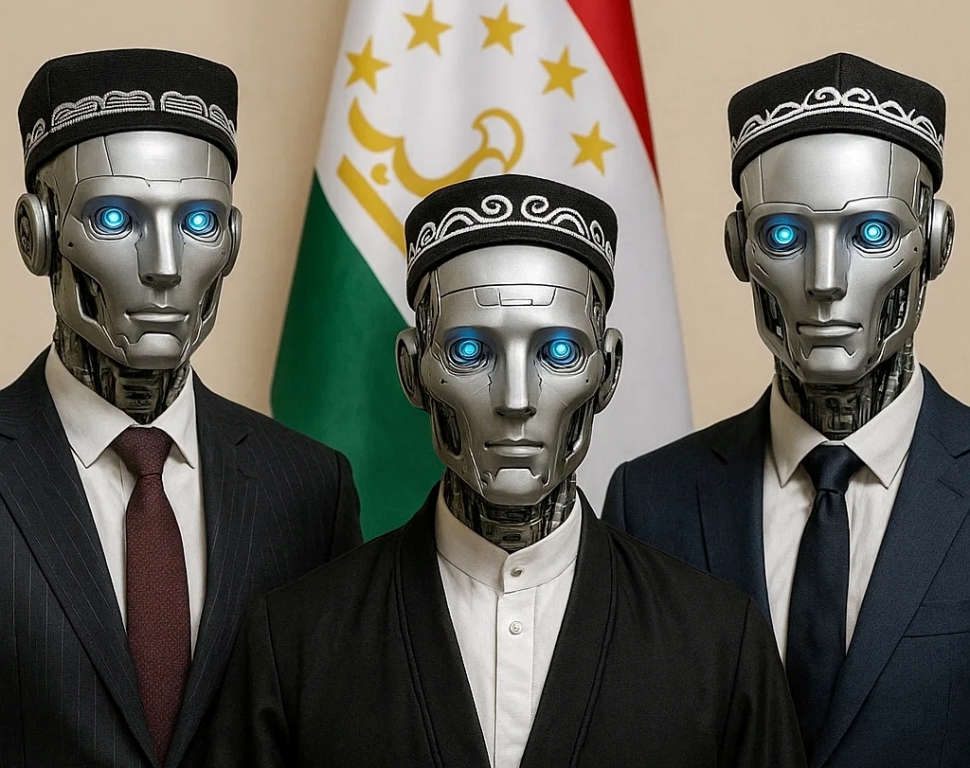
The idea of artificial intelligence taking on government roles is moving from science fiction into reality. In Albania, for the first time worldwide, an AI bot was “appointed” to head the Ministry of Public Procurement, where it now answers citizens’ questions and approves projects. The news sparked global debate — and raised the question: could AI take over leadership roles in Tajikistan?

Where AI could take over
According to ChatGPT, some Tajik institutions are particularly well-suited for digital ministers, primarily those built on numbers, analysis, and data management.
Ministry of Finance
Here, AI could handle up to 85–90% of the technical workload, including: collecting and analyzing budget data; forecasting revenues and expenditures; monitoring spending and flagging irregularities;
managing public debt and risk assessments; and preparing reports for parliament and international organizations.
As experts point out, “a computer won’t misplace a comma or forget a zero.” Still, political will and responsibility remain in human hands.
Tax Committee
With tax systems relying heavily on algorithms and compliance checks, AI could: process tax declarations automatically; detect errors, fraud, and suspicious transactions; model revenue flows; and provide taxpayer services via chatbots and reminders.
AI could replace 70–80% of technical functions, but the role of the chief tax official — who signs documents and assumes responsibility — would remain human.
Agency for statistics
For an AI system, millions of tables are just “morning exercise.” It could: collect and clean massive datasets; detect errors automatically; and produce forecasts and analytical reports.
But a human head would still be needed to set priorities and represent the agency publicly.
Ministry of Economic Development and Trade
Here, AI could forecast GDP and inflation, analyze international markets, and run scenario models. Yet strategy and politics would remain human domains.
Where humans are still essential

Some ministries cannot be automated due to the nature of their work:
- Defense — requires leadership, resilience, and human decision-making in times of crisis.
- Interior Affairs — policing and public safety demand empathy, moral judgment, and citizen interaction.
- Foreign Affairs — diplomacy depends on personal relationships, tact, and charisma, qualities no AI can replicate.
Half-automatic ministries
Certain sectors could benefit from AI support but still require strong human leadership:
- Healthcare — AI could optimize hospital funding, procurement, and patient queues, but crises and communication need people.
- Agriculture — data-driven planning is helpful, yet fieldwork and negotiations demand a minister who speaks “the language of the village.”
- Energy and Transport — AI could manage logistics and monitoring, but not political negotiations or diplomacy.
Advantages of an AI minister
Supporters of the idea note several benefits of AI officials:
- AI doesn’t take bribes;
- Never shows up late;
- Doesn’t get sick (except for computer viruses);
- Remembers everything;
- Works 24/7 without vacations;
- Speaks honestly about resources: “If there’s no money, it will say so directly.”
The road ahead
Experts believe the future of governance could be “hybrid.” In ministries like Finance, Tax, and Statistics, AI may soon become a “super-deputy,” handling most of the technical work flawlessly. Ministers would then have more time to focus on strategy and leadership.
Yet in diplomacy, defense, healthcare, and other people-focused fields, human leadership remains irreplaceable. Empathy, charisma, and the ability to inspire — no algorithm has mastered these traits.