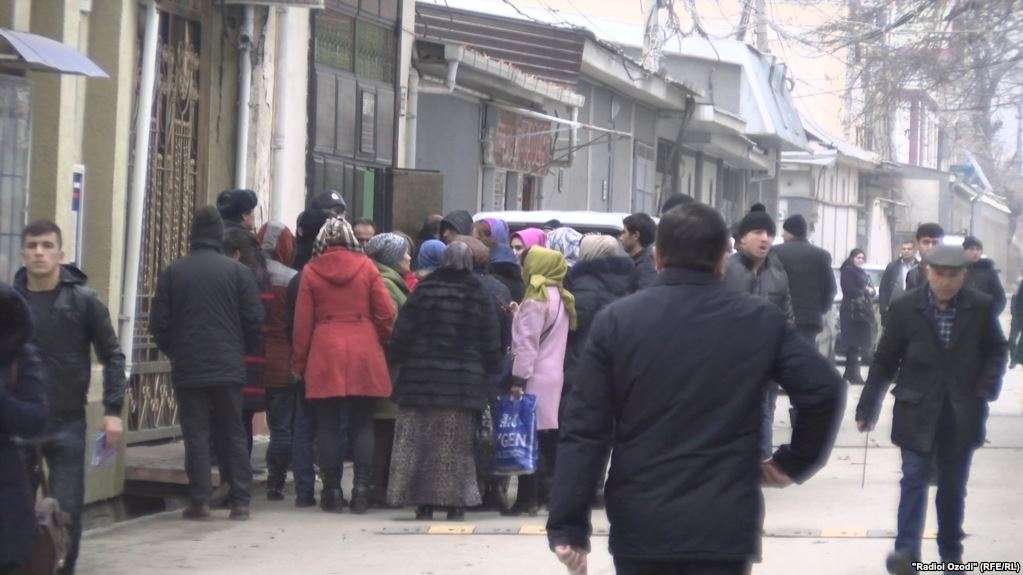
Dushanbe police have been forced to disperse a crowd applicants for Russian national resettlement program outside the Russian Interior Ministry’s representative office in Dushanbe after disorder has occurred.
Thousands of applicants for the National Program for Supporting Voluntary Migration of the Compatriots Residing Abroad to the Russian Federation gathered outside the Russian Interior Ministry’s representative office in Dushanbe on January 9. The employees of the representative office explained them that reception of citizens will not be carried out because of a 10 day New Year break in Russia but they can apply online.
However, the applicants did not want to hear this as they were running out of patience; many of them have been coming to the representative office for already third day.
“The situation got out of control and employees of the representative office were forced to call police. Police officers introduced order and carry out explanatory work,” Umarjon Emomali, a spokesman for the Interior Ministry of Tajikistan, told Asia-Plus in an interview.
The National Program for Supporting Voluntary Migration of the Compatriots Residing Abroad to the Russian Federation, also legally known as the State Program for Assisting Compatriots Residing Abroad in Their Voluntary Resettlement in the Russian Federation was approved in 2006. Russian government officials estimated that more than 25 million people were eligible for the repatriation program, “many of them ethnic Russians who found themselves living in former Soviet republics after the Soviet collapse in 1991.”
The Russian government reportedly spends approximately $150 million a year in support of the program. According to the Russian government, most requests for participation in the program come from “compatriots” living in Kazakhstan, Uzbekistan, Armenia, Ukraine, Moldova, Kyrgyzstan, and Tajikistan.
The program designates the areas in which new arrivals will live in Russia, “providing them with some benefits on the condition that they stay in these regions for at least two years.”