Centrist incumbent President Emmanuel Macron was re-elected for a second term with an estimated 58.2% of the vote, while his far-right challenger Marine Le Pen, took 41.2%. An election has seen the far right come its closest yet to winning power.
France 24, citing an estimate from the IPsos polling institute, said on April 24 that Emmanuel Macron was elected for the second term as French president Sunday evening with 58.8% of the vote.
His far-right challenger Marine Le Pen reportedly won 41.2% of the vote in an election that saw the country’s highest abstention rate in 50 years.
CNN said on April 24 that Macron took 58.55% of Sunday's vote, making him the first French leader to be reelected in 20 years. He and Le Pen advanced to the runoff after finishing in first and second place, respectively, among 12 candidates who ran in the first round on April 10
While the contest was a rematch of the 2017 French presidential runoff, much of Europe watched the election with unease. A Le Pen presidency would have fundamentally changed France's relationship with the European Union and the West, at a time when the bloc and its allies rely on Paris to take a leading role in confronting some of the world's biggest challenges — most notably, the war in Ukraine, according to CNN.
And though Macron's pitch to voters of a globalized, economically liberal France at the head of a muscular European Union won out over Le Pen's vision for a radical shift inward, the 41.45% of people who voted for her put the French far right closer to the presidency than ever before.
CNN says Le Pen's performance is the latest indication that the French public is turning to extremist politicians to voice their dissatisfaction with the status quo. In the first round, far-left and far-right candidates accounted for more than 57% of the ballots cast.
Many of those unsatisfied with the final two candidates stayed home. The voter abstention rate for the runoff was 28%, according to the French Interior Ministry, the highest for a runoff since 2002.
In his victory speech, Macron vowed to be the "president for each and every one of you." Macron said that his second term would not be a continuation of his first, committing to address all of France's current problems.
He also addressed those who supported Le Pen directly, saying that he, as president, must find an answer to "the anger and disagreements" that led them to vote for the far right.
Le Pen reportedly delivered a concession speech within a half hour of the first projection, speaking to her backers. "A great wind of freedom could have blown over our country, but the ballot box decided otherwise," Le Pen said.
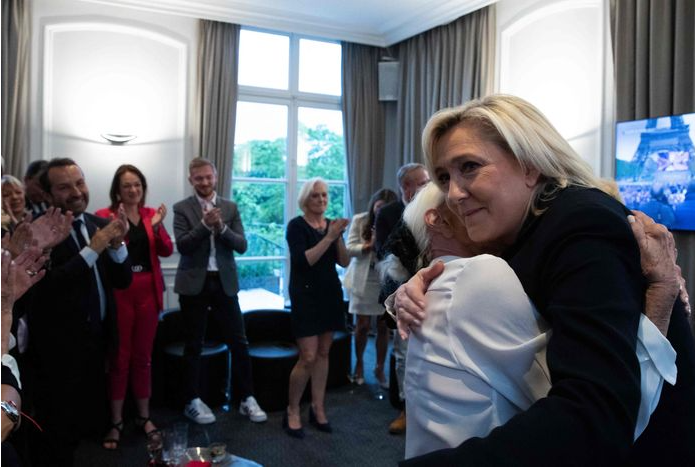
Still, Le Pen acknowledged the fact that the far right had never performed so well in a presidential election. She called the result "historic" and a "shining victory" that put her political party, National Rally, "in an excellent position" for June's parliamentary elections. "The game is not quite over," she said.