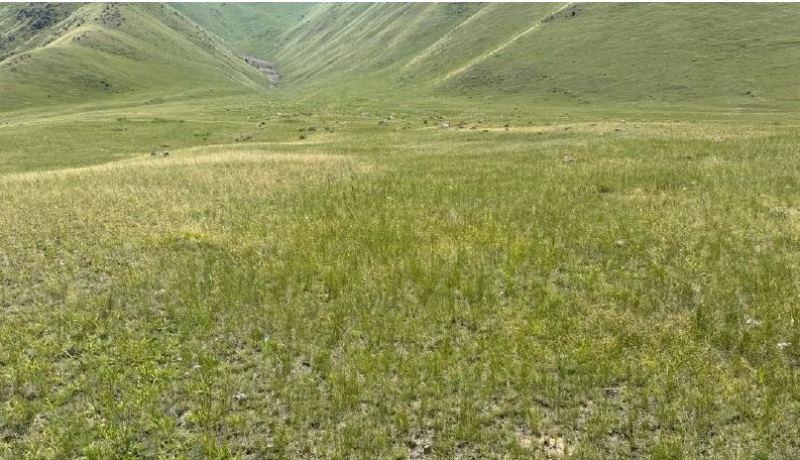
Experts say degradation of lands occurs in Kyrgyzstan due to growing livestock numbers, uncontrolled cattle grazing and climate change. Some plots, specialists say, are exposed to degradation in 70%-80%.
Many problems
Kyrgyzstan reportedly has over 9 million hectares of pasture lands. Natural pastures were and will be the largest and cheapest sources of fodder. But because of the annual burden and lack of proper maintenance, they produce less fodder due to degradation and erosion processes.
Natalia Kilyazova, chief of the Pasture and Fodder Department of the Kyrgyz Research Institute for Livestock Farming and Pastures (NIIJP), explained that natural pastures and hayfields are composed of desert, semi-desert, steppe, meadow-steppe, and meadow (high mountain, subalpine, and alpine) ones by the nature of vegetation. The biggest area, according to her, is occupied by steppe pastures (3.1 million hectares), little less area is occupied by meadow-steppe pastures (2.4 million hectares), meadow pastures (1.3 million hectares), desert (1.8 million hectares), and comparatively smaller area is occupied by high mountain tundra-like pastures (0.15 million hectares).
There is an acceptable height of grazing for re-vegetation peculiar to every type. For example, meadow pastures must have 5-7 centimeters of vegetation remaining, while steppe pastures must have at least 2 centimeters.
However, there are frequent cases of early grazing, when a stand of grass has not still reached the pasture maturity and does not have the sufficient amount of nutrients, as well as excessive grazing, when animals eat plants literally to the root and the soil becomes exposed.
Some pasture lands, according to Natalia Kilyazova, are exposed to degradation in 70-80 per cent, but it does not mean that it has reached this level.
Pastures near villages were reportedly degraded the most as grazing schedules were disrupted.
However, distant pastures are often not used. Back in the Soviet period, the cattle was driven in an organized way with the state support. Now the infrastructure is destroyed and needs to be recovered. And the most important thing is that there are no water sources, which a shepherd needs to have when driving the cattle.
Climate change also has led to the shift in seasons. Grass reportedly starts to grow earlier and finish earlier in grasslands. As a result, pastures get dry in August and livestock have nothing to eat. So, livestock need to be driven to other pastures. So, diseases and pests develop.
Undergrazing is bad, too
According to Myktybek Kalandarov, director of Department of Livestock Breeding, Pastures and Fodders, 137,000 hectares of pastures degraded in Kyrgyzstan; 614,000 hectares are considered underproductive, they are mainly lands near villages.
Experts warn: if the process of worsening pasture conditions is not stopped, it can lead to deplorable consequences, when the land productivity cannot be raised.
According to specialists, underutilization of pastures causes damage as well. It is even worse when pastures are not used at all. The dead sod develops in the pastures: the grass accumulates, dies, accumulates again, and over time only strong weed plants can penetrate through it. Therefore, it is important to use allocation so that all lands could be involved in the system.
Invasion of weeds
Weeds can cause a serious problem, too. Suusamyr Valley with over 470 thousand hectares of pastures has recently faced the increase in the area of wild prickly pea-shrubs (Caragana), which lead to extinction of some species of fodder grasses. This year, the valley has faced another problem – locust, which destroys nutritious grass.
The primary attention in the weed control in the pastures should be given to preventive measures, i.e. prevention of weed invasion. Mechanical, biological and chemical methods are used to fight the weeds.
Resources are not endless
According to the National Statistical Committee, there are over 6 million sheep and goats (small cattle), 1.8 million heads of cattle, over 500 thousand horses in the country. And the livestock is increasing every year.
According to Myktybek Kalandarov, there is a large number of cattle and sheep and goats in Kyrgyzstan, while their yield is low, so the department pays particular attention to upgrading of breeding animals.
Moreover, pasture fees are going to be increased. Local councils approve the cost of cattle grazing.
What to do?
The most important thing, according to Natalia Kilyazova, is to use pastures systematically. Therefore, it is important to train farmers. To this end, the research institute publishes brochures, booklets, organizes outdoor training events.
NIIJP has developed a system to improve pastures. The approach to agricultural lands must be individual. It is enough to irrigate some pastures, spread fertilizers in other pastures, while other pastures need to have rotational grazing, use enclosure-pasturing system, overseeding.
During the project, NIIJP made a research across the country and organized demo plots, which were enclosed by barbed wire to restrict access to livestock. The soil held a reserve of seeds, and within a year, the grass stand noticeably restored itself.