Two different UN resolutions regarding Russia’s war against Ukraine

On Monday February 24, the UN Security Council approved a U.S.-proposed resolution, reflecting Washington’s shift in stance on Russia’s war against Ukraine.   The BBC’s Russian Service reports that the brief text does not condemn Russian aggression but merely calls for peace. The resolution, titled The Path to Peace, reportedly consists of three paragraphs and […]

Asia-Plus

On Monday February 24, the UN Security Council approved a U.S.-proposed resolution, reflecting Washington’s shift in stance on Russia’s war against Ukraine.  

The BBC’s Russian Service reports that the brief text does not condemn Russian aggression but merely calls for peace.

The resolution, titled The Path to Peace, reportedly consists of three paragraphs and was supported by eight Security Council members, including the U.S., Russia, and China.  Five countries, including France and the United Kingdom, abstained.

The Deutsche Welle says this marks the first time since the start of the war in Ukraine that the UN Security Council has managed to pass a resolution on the issue.

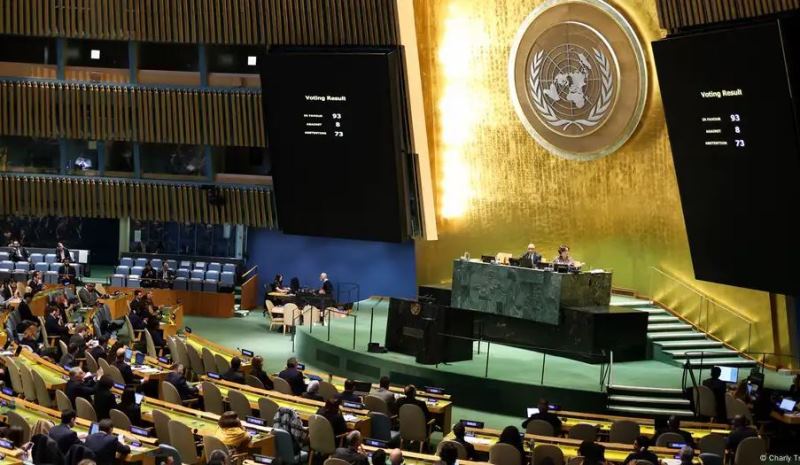
Earlier the same day, the UN General Assembly adopted two separate resolutions, each differing in their assessment of Russia’s war against Ukraine.

The first resolution was drafted by Ukraine and EU countries.  It explicitly demanded that Russia immediately withdraw its troops from occupied Ukrainian territories and cease hostilities, aligning with previously adopted UN decisions.  This resolution was supported by 93 countries, while 65 abstained, and 18—including Russia and the U.S.—voted against it.

The second resolution was proposed by the United States.  It did not condemn Russia’s military aggression, referred to the war as a "conflict," and omitted mentions of Russian-occupied Ukrainian territories, violations of international law by Russia, and the need to restore Ukraine’s territorial integrity.

Following amendments initiated by European countries, the final version of the resolution included references to Ukraine’s territorial integrity and the goal of achieving a "just peace."  The document was supported by 93 countries, while 72—including the U.S. and Ukraine—abstained. Russia voted against it.

On February 24, the European Union approved its 16th package of sanctions against 48 individuals and 35 legal entities in Russia responsible for “undermining Ukraine’s sovereignty.”  Australia also introduced its largest package of anti-Russian sanctions since the beginning of the war in Ukraine.



Article translations:

Related Article

Оби зулол

Most Read

Join us on social media!

Recent Articles

Mudflows and dust storms expected in Tajikistan

Citizens are urged to protect themselves from dust.

Russia doubles temporary stay duration for truck drivers from CIS and Georgia

Tajik drivers will have their term increased from 90 to 180 days a year.

How a guide dog project could help people with visual impairments in Tajikistan

In Tajikistan, there is an enthusiast who can build such a school, but he urgently needs help, primarily financial.

Wildberries opened access to the platform for all sellers from Tajikistan

Now local brands, manufacturers, and individual entrepreneurs can enter the largest online platform and expand their sales market.

CMWP Uzbekistan: The boutique hotel market in Tajikistan shows the fastest growth in the region

Such hotels in the republic offer their guests a high level of comfort and convenience.

Emomali Rahmon signs decree on increasing salaries and paying bonuses to IT sector workers

The document provides for the creation of a new incentive system for specialists in the field of information technology.

Not advertising, but influence: what was discussed at IMPACT Creative Night and why businesses need meaning today

Today, audiences trust direct advertising less and less, which means brands have to compete not for attention, but for trust and a place in the agenda.

Russia extends the experiment on collecting biometrics from foreigners

The decision was justified by the necessity of gradually modernizing all border crossing points.

“Convenient, affordable, and cheap”: Dushanbe residents speak out on raids against shared taxis

They say that late at night buses and trolleybuses disappear from the streets, so cheap route taxis remain the only way for many to get home.