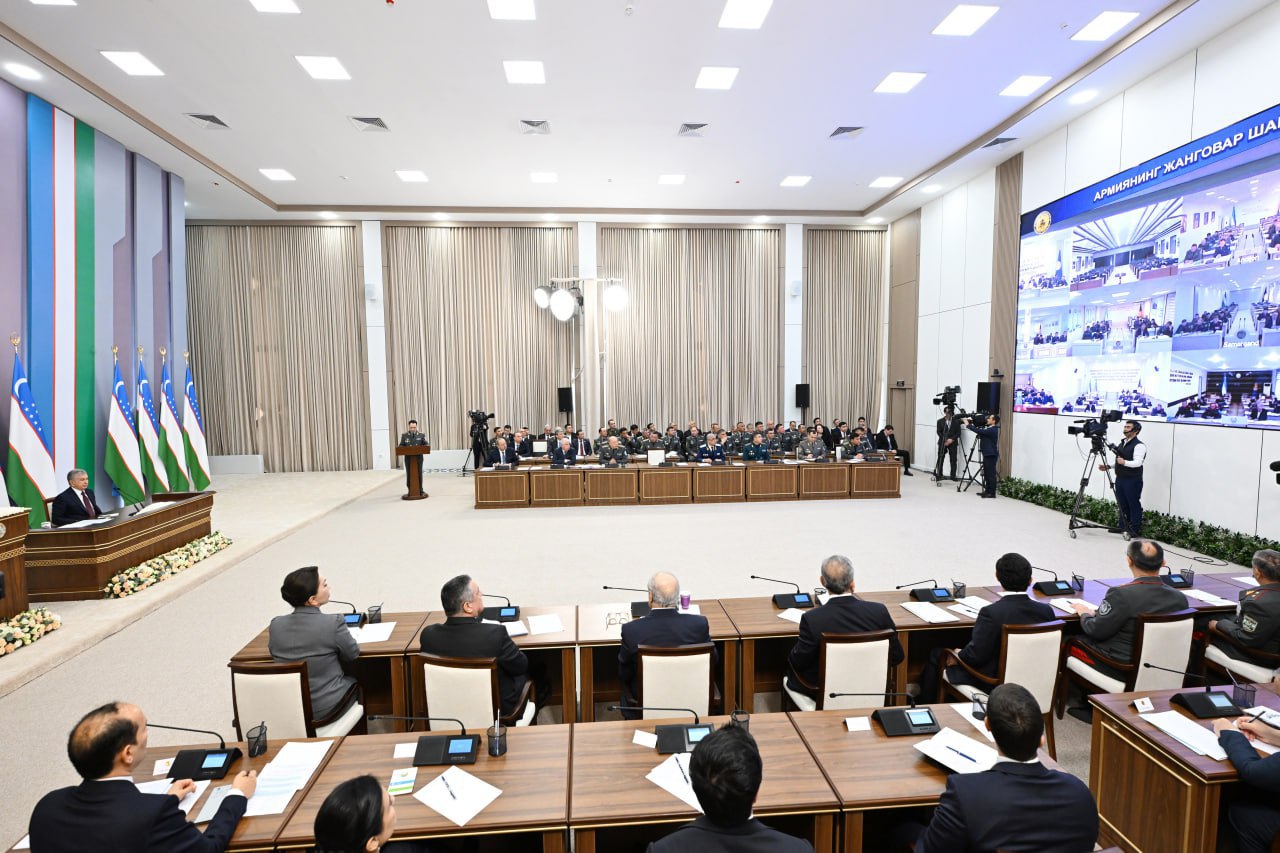
Uzbek President Shavkat Mirziyoyev has called for a revision of the country’s Defense Doctrine and National Security Concept in light of fundamental changes in the nature of modern warfare. He made the statement on January 13 during an expanded meeting of the Security Council chaired by the head of state, according to the Uzbek president’s official website.
Addressing the current international situation, Mirziyoyev pointed to the growing number of regional conflicts, the intensification of the global arms race, and the declining role of international law and diplomacy.
“It is crucial to understand one thing: the nature of modern warfare has fundamentally changed. Anyone who believes victory can be achieved solely through the number of tanks, aircraft, or soldiers is deeply mistaken. Today’s conflicts are waged using artificial intelligence, digital command and control systems, long-range precision strike capabilities, cyber and robotic technologies, as well as political and economic pressure,” the president said.
In this context, Mirziyoyev emphasized that peace and stability are becoming the country’s greatest assets, and that all sectors must operate in a proactive mode, responding in advance to potential threats.
Taking into account new challenges and risks, the president instructed officials to review the Defense Doctrine adopted eight years ago, as well as the National Security Concept dating back to 1997. According to him, the new doctrine should preserve Uzbekistan’s non-alignment status, rely on multilateral diplomacy, and serve as a foundation for the technological modernization of the armed forces.
“Overall, the new doctrine should become the basis for upgrading the army through advanced military technologies and solutions,” the head of state noted.
The meeting highlighted that significant efforts have been made in recent years to strengthen the country’s defense capabilities. The national armed forces are being equipped with modern weapons and military hardware, combat readiness and the moral and psychological training of personnel are improving, and the defense industry is actively developing.
New tactical approaches have been introduced in the armed forces, the number and intensity of military exercises have increased by 1.5 times, and dedicated units for unmanned aerial vehicles as well as specialized training centers have been established. The digitalization of the army has also delivered tangible results, enhancing command efficiency and information security.
Special attention was paid to the military education system. On the president’s initiative, it has undergone comprehensive modernization, including the establishment of the University of Military Security and Defense and the introduction of digital learning technologies, including those based on artificial intelligence.
Further improvement of military personnel training was identified as a key long-term priority.
“It must not be forgotten that modernizing the military education system and personnel training is the main prerequisite for shaping a new image of the army,” Mirziyoyev stressed.
Particular emphasis was placed on reforming compulsory military service. It should become not only a stage of military training but also an opportunity to acquire professional skills and prepare for the labor market. A new vocational training system with certification will be introduced within the armed forces, and each year 5,000 conscripts will be able to study under the “One Million Programmers” and “Five Million AI Leaders” programs.
“In short, compulsory military service should become a pathway to success for young people,” the president said.
Tasks were also outlined to further develop cybersecurity, enhance engineering and technical capacity, establish military technoparks, and equip the armed forces with AI-based robotic systems and unmanned platforms.