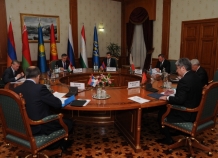
DUSHANBE, April 2, 2015, Asia-Plus — A meeting of the Collective Security Treaty Organization (CSTO) Foreign Ministers’ Council took place in Dushanbe on April 2.
The meeting brought together foreign ministers of Tajikistan (Sirojiddin Aslov), Armenia (Edvard Nalbaldyan), Belarus (Vladimir Makey), Kazakhstan (Erlan Idrisov), Kyrgyzstan (Erlan Abdyldayev), and Russia (Sergey Lavrov) to review modern problems of international policy and measures to address modern challenges and threats.
As Dushanbe chairs the organization in 2015, the meeting was chaired by Tajik Foreign Minister Sirojiddin Aslov.
Sirojidin Aslov told journalists after the meeting that the CSTO foreign ministers adopted a joint statement on the 70th anniversary of the Victory in the Great Patriotic War of 1941-1945.
According to him, the statement, in particular, notes that it is inadmissible to revise outcomes of the Great Patriotic War of 1941-1945.
Aslov said the ministers discussed the situation in the CSTO area of responsibility (AoR) and in neighboring regions, including Afghanistan.
Tajik minister noted that Tajikistan had called on its partners to take concrete measures to help increase security along its common border with Afghanistan.
“I informed my colleagues about steps taken by Tajikistan to minimize effects of new challenges and threats we face,” Aslov said, noting that the meeting also discussed Tajikistan’s steps to widen ties with Afghanistan.
Tajik minister said the meeting also discussed issues related to the CSTO’s cooperation with international bodies such as the United Nations and joint efforts against terrorism, extremism, transnational crime, and cybercrime.
The CSTO Foreign Ministers Council is a charter body of the organization which holds sessions twice a year: in the run-up to a session of the Collective Security Treaty Organization (the end of the calendar year) and in between sessions (second quarter). The meeting of the council in between sessions is organized in the state which holds the CSTO chairmanship.
The regional security organization was initially set up in 1992 in a meeting in Tashkent and Uzbekistan once already suspended its membership in 1999. However, Tashkent returned to the CSTO again in 2006 The regional security organization was initially formed in 1992 for a five-year period by the members of the CIS Collective Security Treaty (CST) — Armenia, Kazakhstan, Kyrgyzstan, Russia, Tajikistan, and Uzbekistan, which were joined by Azerbaijan, Georgia, and Belarus the following year. A 1994 treaty reaffirmed the desire of all participating states to abstain from the use or threat of force, and prevented signatories from joining any “other military alliances or other groups of states” directed against members states. The CST was then extended for another five-year term in April 1999, and was signed by the presidents of Armenia, Belarus, Kazakhstan, Kyrgyzstan, Russia, and Tajikistan. In October 2002, the group was renamed as the CSTO. Uzbekistan that suspended its membership in 1999 returned to the CSTO again in 2006 after it came under international criticism for its brutal crackdown of antigovernment demonstrations in the eastern city of Andijon in May 2005. On June 28, 2012, Uzbekistan announced that it has suspended its membership of the CSTO, saying the organization ignores Uzbekistan and does not consider its views. The CSTO is currently an observer organization at the United Nations General Assembly.