


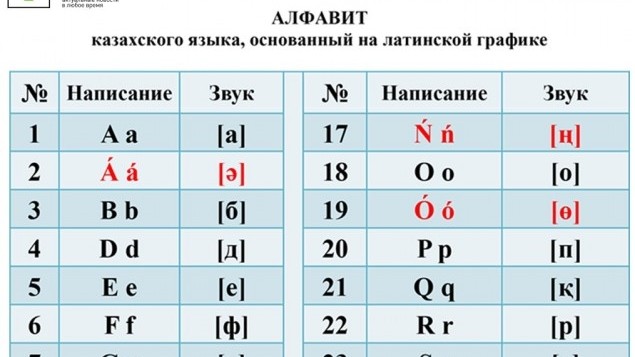
Kazakh president approves new Kazakh alphabet based on Latin script

The President of Kazakhstan, Nursultan Nazarbayev, has signed a decree approving a new Kazakh alphabet based on Latin script, Ak Orda, the official workplace of the President of Kazakhstan, said.   Nursultan Nazarbayev has laid out a timeline to switch the country's writing system over from the Cyrillic to the Latin script.  The change should be […]

admin

The President of Kazakhstan, Nursultan Nazarbayev, has signed a decree approving a new Kazakh alphabet based on Latin script, Ak Orda, the official workplace of the President of Kazakhstan, said.  

Nursultan Nazarbayev has laid out a timeline to switch the country's writing system over from the Cyrillic to the Latin script.  The change should be fully effective by 2025.

Recall, Nursultan Nazarbayev signed an executive order on October 27, 2017 telling his government to prepare the Kazakh alphabet for a transition to Latin letters from Cyrillic ones by 2025.

"The government of Kazakhstan is to set up a national commission to change the Kazakh alphabet to Latin script; organize a gradual switch to Latin script by 2025," the document circulated to state media read.

Kazakh president authored an article, on April 12, 2017 in the state-run newspaper Egemen Kazakhstan (Independent Kazakhstan) under the title “Looking into the Future: Modernization of Public Conscience.”  In his article, the president, in particular, suggested changing the current Kazakh alphabet from Cyrillic to Latin.  The whole process, he declares, needs to be finalized by 2025.

A special commission was set up on April 13 to working on creating “the most appropriate” variant of the Latin-based script for the Kazakh language.”

Meanwhile, some experts consider that the move is seen as an effort to emphasize Kazakh culture and distance the country from Russia.

The Latin alphabet was used in Kazakhstan between 1929 and 1940, when Soviet authorities decided it was time to switch back to Cyrillic.  In fact, a special, so-called “missionary” version of Cyrillic had been developed in the 19th century by learned Russian immigrants settled in Kazakh lands as part of the geographic expansion of the Russian Empire into Central Asia.  A prominent Kazakh educator, Ybray Altynsarin, had greatly contributed to the mass introduction of Cyrillic among native Kazakh speakers.  It was in use until the October Revolution of 1917.  Prior to that, Kazakhs had been using a 29-character Arabic script with a few modifications to reflect phonetic specificities. Written Arabic had been present throughout Kazakhstan since the tenth century.

Tengrinews.kz reported on April 14, 2017 that for Nazarbayev, the 1940 decision to return to Cyrillic was purely “political” and did not reflect the cultural reality of Kazakhstan nor its linguistic history.

Join us on social media!

Article translations:

Related Article

Оби зулол
Оби зулол

Most Read

Акика Алиф

Recent Articles

In Tajikistan, a unique surgery was performed for the first time on a child with an extremely rare pathology

Tajik and Russian surgeons successfully performed the most complex reconstruction of the bladder and abdominal wall for a child with recurrent exstrophy.

The ministry of health states that hantavirus does not threaten Tajikistan

Cases of infection with this virus were detected on board the cruise liner Hondius near the Canary Islands.

Tajikistan lags behind other Central Asian countries in number of chain hotels – study

The Republic remains a niche market with a limited number of quality hotels.

Climate risks threaten food security in Central Asia – FAO

Land degradation reduces agricultural productivity. The loss of biodiversity weakens the ecosystems that farmers, livestock breeders, and rural communities depend on.

Potential or illusion? Why the world overlooks Tajikistan’s mineral wealth

The republic may indeed possess significant reserves of rare metals, but there is a catch...

The case of ousted Kyrgyz security boss classified and moves to court

The former head of the GKNB is charged with violent seizure of power and abuse of official position.

Trump states that Iran’s nuclear program is a higher priority than U.S. citizens’ economic issues

Fluctuations in energy prices led to record inflation in the United States in April, the highest in the past three years.

Foot-and-mouth disease, plague, and flu: Central Asia threatened by transboundary animal diseases

FAO urges Central Asian countries to strengthen coordination and epidemiological surveillance.

Tajikistan approves the second phase of the Electric Transport Development Program; $95 million will be allocated for its implementation.

At this stage, the authorities are focusing on charging infrastructure, services for electric vehicles, and the expansion of the electric bus fleet.

Tajikistan and Kazakhstan to sign roadmap for cooperation in the agrarian sector

The parties are interested in expanding investment cooperation and establishing joint ventures.