

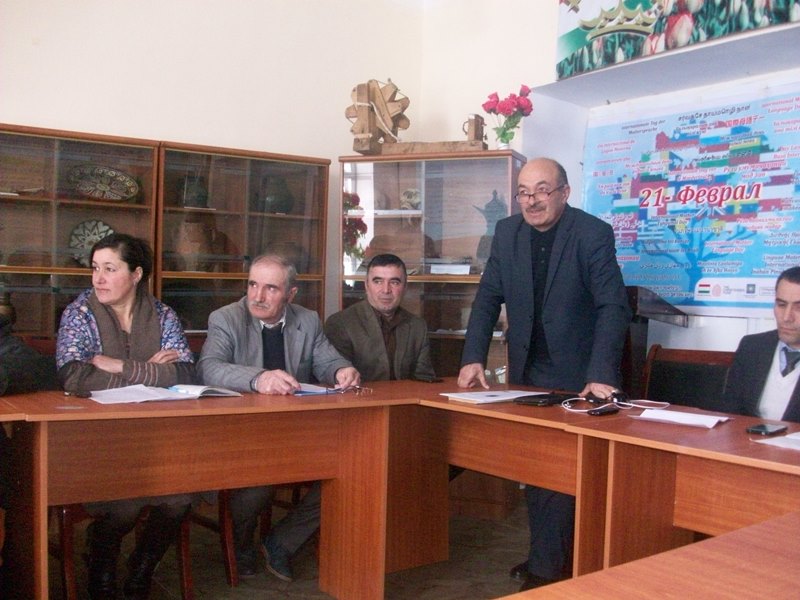
The Institute of Humanities named after Academician Bahodur Iskandarov, which is based in Khorog, the capital of the Gorno Badakhshan Autonomous Region (GBAO), on February 21 held a roundtable on the occasion of International Mother Language Day.
The roundtable entitled “The Pamir Languages: Threat of Globalism” brought together researchers from the Institute of Humanities and teachers and students from Khorog State University named after Moyonsho Nazarshoyev.
The roundtable participants, in particular, noted that global political and economic changes, expansion of migration processes, lack of teaching the mentioned languages in schools and lack of an official use of these languages on the Internet put the small languages under the threat of disappearance.
Currently, seven OLD Tajik languages are spoken in Tajikistan: the Yaghnobi language in the Sughd; and Shughni, Rushani, Roshorvi, Yazgulyami, Ishkashimi, and Wakhi in the Gorno Badakhshan Autonomous Region.
The Pamir languages are a subgroup of the Eastern Iranian languages, spoken by Pamiri people in the Pamir Mountains, primarily along the Panj River and its tributaries. This includes the Badakhshan Province of northeastern Afghanistan and the Gorno Badakhshan Autonomous Region in Tajikistan. Smaller communities can be found in the adjacent areas of Pakistan where many have settled in recent decades. Sarikoli, one of the languages of the Pamir group, is spoken beyond the Sarikoli ridge on the Afghanistan-China border, and thus qualifies as the eastern-most of the extant Iranian languages.
Members of the Pamir language group include Shughni, Sarikoli, Yazgulyami, Munji, Sanglechi-Ishkashimi, Wakhi, and Yidha. These are Southeastern Iranian languages.
The Yaghnobi language is also a living East Iranian language. Yaghnobi is spoken in the upper valley of the Yaghnob River in the Zarafshon area of Tajikistan by the Yaghnobi people. It is considered to be a direct descendant of Sogdian and has often been called Neo-Sogdian in academic literature.
International Mother Language Day (IMLD) is a worldwide annual observance held on February 21 to promote awareness of linguistic and cultural diversity and promote multilingualism. First announced by UNESCO on November 17, 1999, it was formally recognized by the United Nations General Assembly in a resolution establishing 2008 as the International Year of Languages.