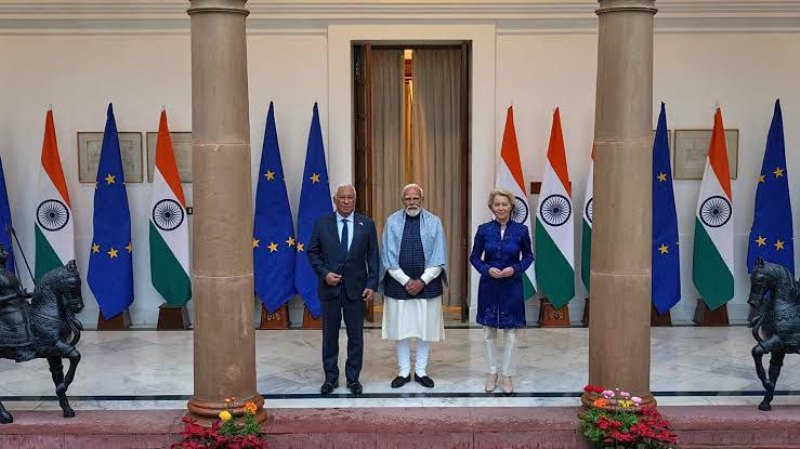
India's landmark deals with the European Union (EU) and the United States (US) within a week have underscored its importance and prominence in the global economy and geopolitics, highlighting its changing role in the multipolar, fractured world order. India has successfully drawn the EU and the US alongside Russia into its circle of strategic partners, signalling that it is no longer merely a rule-taker in the global order, but a key rule-shaping power at the centre of an emerging multipolar world.1[1]
The Indo-Europe Free Trade Agreement (FTA) deal would impact the two billion population and almost a quarter of the global GDP.[2] More importantly, it would create the world's largest free trade zone, boost business activities, while supporting the EU's 'new Europe' strategy.[3] European Council President António Costa termed the trade pact with India the 'mother of all deals', saying it would stabilise the global economy. "The deal has great value from an economic view, but perhaps more important is the message that the two largest democracies in the world are sending to the international community," Costa said.[4]
Striking trade partnership with India is set to help Europe in strengthening its economic and political weight in the global affairs, said Alberto Rizzi, Policy Fellow at the European Council on Foreign Relations. "In reality, this deal is about much more than bilateral trade. For Europe, it is the first step towards building a broader partnership with the fastest-growing G 20 economy. The deal is essential to safeguard a global multilateral trade system being torn apart by US tariffs, Chinese export restrictions, and other unilateral measures," Rizzi said.[5]
The FTA is crucial for globalisation and trade diversification as it "meaningfully" reshaped the movement of trade, investment, and supply chains, said Rituparna Majumdar, Economic Analyst with Frost & Sullivan, an American business consulting firm. "Beyond its symbolic value, the agreement promises to reshape trade architecture, bolster supply chain resilience, and recalibrate strategic alignments across Asia, Europe, and the Atlantic," Majumdar said.
According to the India-EU Trade Council, a policy-oriented organisation, the deal ensured that the era of free trade still existed amid the threats of customs duties and geopolitical tensions. "At a time when global trade is becoming increasingly protectionist and where geopolitical rivalry growing, this agreement provides an opportunity to recalibrate commercial alignment," it said."It is also an opportunity to reshape commercial architecture while building supply chain resilience across Asia, Europe and the Atlantic."[6]
Indian Prime Minister Narendra Modi said the trade pacts instilled confidence in the world that it was moving towards global stability. "The agreement with European Union gave the world confidence in global stability, and the US deal reinforced the sense of momentum, both serving as positive signals for the world," he said. "In the post-COVID world, as global instability grows, a new world order is emerging, and impartial analysis shows a clear tilt towards India.[7]
The subsequent deal with the US assured the world about global certainty, Modi said. "Global trust in India is growing. After the trade deal with the US, the world became even more confident that with stability, they can sense a speed too. This is a positive sign for the world. Big countries are very eager to have trade relations with India," he said.[8] The Indo-us pact will have a broader global impact beyond just bilateral commerce as it would influence how the global economy, production and global risks are influenced.
US Trade Representative Jamieson Greer praised the trade deal with India as it would help reshape the global supply chain. He said India's involvement would not just make the global supply chain efficient but geopolitically secure.[9] India received one of the most favourable deals, as the 18 percent tariff rate is the lowest among South Asian and Southeast Asian countries.
The Indo-Us trade agreement is beyond conventional merchandise exchanges, as it is forward-looking and rests on structural complementarity, said strategic expert and historian Saroj Kumar Rath. "Indo-US trade uniquely combines economic complementarity, technological upgrading and geopolitical convergence, making it India's most strategically consequential bilateral trade relationship today," he said.[10]
[1] https://www.hindustantimes.com/india-news/point-blank-india-eu-mega-trade-deal-a-signal-of-a-multipolar-world-101769499783680.html
[2] https://ec.europa.eu/commission/presscorner/detail/en/ac_26_253
[3] https://www.weforum.org/stories/2026/o2/india-eu-mother-of-all-trade-deals-what-to-know/
[4] https://www.euronews.com/my-europe/2026/01/28/india-trade-deal-cements-eus-voice-in-multipolar-world-costa-tells-euronews
[5] https://ecfr.eu/article/its-the-geoeconomy-stupid-why-the-eu-india-deal-matters-beyond-trade/
[6] https://eu-india.org/2026/02/06/the-eu-india-deal-is-huge-and-it-illustrates-the-changing-role-of-trade-in-a-fractured-world-order/
[7] https://www.newsonair.gov.in/india-has-emerged-as-trusted-partner-in-fast-progressing-global-order-govt-is-moving-ahead-with-vision-of-reform-perform-transform-pm-modi/
[8] https://www.financialexpress.com/india-news/pm-modis-rajya-sabha-top-quotes-world-is-confident-of-stability-after-indias-trade-deals-with-eu-us/4132355/
[9] https://economictimes.indiatimes.com/news/economy/foreign-trade/india-deal-will-reverberate-for-years-us-trade-chief-backs-delhi-as-china-alternative/articleshow/128202009.cms?from=mdr
[10] 1https://asiatimes.com/2026/02/what-the-us-india-trade-deal-really-means/