CABAR.asia reported today that unknown individuals burned national flags and replaced them with banners bearing Arabic inscriptions, which experts interpret as an act of religious extremism, in Jalal-Abad region. Analysts believe that arrests and punishments are insufficient to address the root of the problem. A true solution requires long-term religious education, whose results will take time to manifest but will be more sustainable.
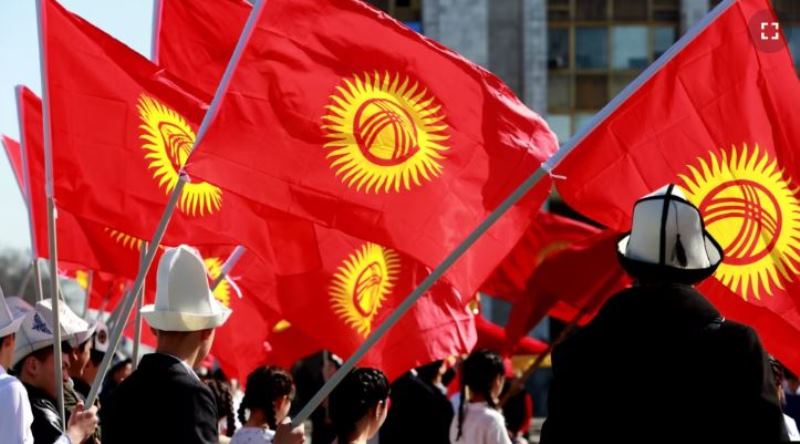
Unknown individuals reportedly burned the national flags of Kyrgyzstan displayed on the buildings of two schools and the aiyl okmotu (village administration) in Bek-Abad vilalge, Suzak district of Jalal-Abad region on the night of May 30. In their place, white flags with Arabic inscriptions were raised, the content of which has not yet been disclosed.
On May 31, six people were reportedly detained in the same district on suspicion of having ties with the banned religious extremist group Hizb ut-Tahrir al-Islami. During searches, numerous extremist materials were found. The connection of the detainees to the flag incident has not been specified.
In Kyrgyzstan, the activities of 21 extremist, terrorist, and destructive organizations are banned by the judicial authorities.
The white flag with black Arabic inscriptions is often associated with radical Islamist groups. For instance, such a flag may be used by organizations that identify with jihadist ideology or seek to establish an Islamic state. One of the most well-known groups using black inscriptions on a white background in their symbolism is Hizb ut-Tahrir, known for its attempts to establish a caliphate, rejecting modern state borders and political systems.
While law enforcement agencies are conducting an investigation, the Spiritual Administration of Muslims of Kyrgyzstan has urged the people not to succumb to provocations and to value freedom, including religious freedom.
However, religious scholar Elmurad Kochkor uulu says such appeals and explanatory work from the Muftiate are unlikely to achieve the desired result. According to him, the roots of the flag-burning incident run deep, and the fight must be waged not only against the manifestations but also against the root causes of such actions.
Kochkor uulu suggested motives behind the actions of those involved in burning the flag. In his view, their actions convey two main messages: the need to transform the state governance system into a religious one and the establishment of a caliphate.
Edil Marlis uulu, an expert in security, expert believes that the flag burning once again exposed all the problems of religious policy and demonstrated that Kyrgyzstan is losing the fight against extremism. He also pointed out the mistakes of the authorities, which, in his opinion, are playing with religious organizations.
According to him, Kyrgyzstan, under both previous presidents and the current administration, is toying with religious organizations, various movements, and funds. The authorities reportedly allow them into the country, enabling them to influence young people with immature minds who lack deep religious knowledge.
Law enforcement agencies must do their job, and that is important too. However, experts believe that the only solution that will yield long-term and sustainable results is education. Global practice shows that extremism cannot be defeated by arrests and criminal cases alone.
Experts suggest that if Kyrgyzstan maintains its current religious policy and level of education, the country will face more serious religious problems in less than 20 years.