Tajikistan ratifies border cooperation agreement with Russia

DUSHANBE, February 29, 2012, Asia-Plus  — Deputies of the Majlisi Namoyandagon (Tajikistan’s lower chamber of parliament) have ratified an agreement between Tajikistan and the Russian Federation on border cooperation issues. A regular sitting of the third session of the Majlisi Namoyandagon of the fourth convocation, presided over by its head, Shukurjon Zuhurov, was held on […]

Payrav Chorshanbiyev

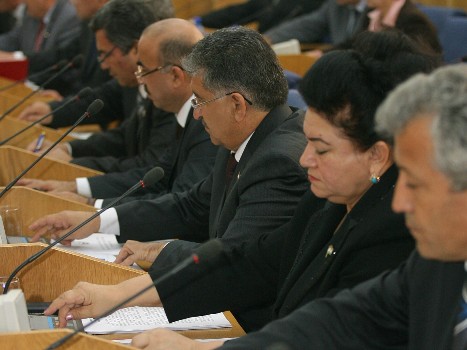
DUSHANBE, February 29, 2012, Asia-Plus  — Deputies of the Majlisi Namoyandagon (Tajikistan’s lower chamber of parliament) have ratified an agreement between Tajikistan and the Russian Federation on border cooperation issues.

A regular sitting of the third session of the Majlisi Namoyandagon of the fourth convocation, presided over by its head, Shukurjon Zuhurov, was held on February 29.

Presenting the document, Lieutenant-General Sherali Mirzo, Head of the Border Guard Directorate within Tajikistan’s State Committee for National Security (SCNS), noted that it, in particular, provided for keeping Russia’s presence in Tajikistan through the group of the border-guard cooperation of Russia’s Federal Security Service (FSB) in Tajikistan, participation of Russian representatives in improving the border control system and ensuring border security of Tajikistan, training of personnel for Tajik border service as well as cooperation in countering terrorism, religious extremism, illegal migration and transnational organized crime.

This agreement was signed by President Emomali Rahmon and his Russian counterpart Dmitry Medvedev in Dushanbe on September 2, 2011.

Russia’s upper house (Federation Council) ratified the Russian-Tajik agreement on border cooperation issues on February 22.

The agreement is reportedly signed for five years with automatic prolongation for the next five-year period.

We will recall that Tajik and Russian border guards discussed a new draft agreement on the border-control cooperation issues last year.

When Russian border guards left Tajikistan in 2005 the two sides signed a five-year cooperation agreement that expired last year.  Russian border guards controlled the Tajik-Afghan border for more than 100 years before handing over responsibility to their Tajik colleagues in 2005.  But Russian boarder-guard advisers continue to be deployed in Tajikistan.

Negotiations that were conducted between Tajik and Russian border services last year focused on the status and tasks of those Russian border-guard advisers.  

Join us on social media!

Article translations:

Related Article

Оби зулол
Оби зулол

Most Read

Акика Алиф

Recent Articles

Trump calls Xi Jinping a “great leader” at meeting in Beijing

During negotiations in Beijing, U.S. President Donald Trump highly praised the relations with Chinese President Xi Jinping, calling him a great leader. “It is a...

Donald Trump arrives in Beijing

Trump will spend three days in China.

In Tajikistan, a unique surgery was performed for the first time on a child with an extremely rare pathology

Tajik and Russian surgeons successfully performed the most complex reconstruction of the bladder and abdominal wall for a child with recurrent exstrophy.

The ministry of health states that hantavirus does not threaten Tajikistan

Cases of infection with this virus were detected on board the cruise liner Hondius near the Canary Islands.

Tajikistan lags behind other Central Asian countries in number of chain hotels – study

The Republic remains a niche market with a limited number of quality hotels.

Climate risks threaten food security in Central Asia – FAO

Land degradation reduces agricultural productivity. The loss of biodiversity weakens the ecosystems that farmers, livestock breeders, and rural communities depend on.

Potential or illusion? Why the world overlooks Tajikistan’s mineral wealth

The republic may indeed possess significant reserves of rare metals, but there is a catch...

The case of ousted Kyrgyz security boss classified and moves to court

The former head of the GKNB is charged with violent seizure of power and abuse of official position.