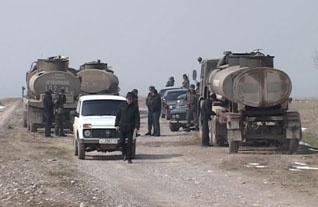
Kyrgyz Prime Minister Omurbek Babanov on Tuesday held a working session with top law enforcement officials of the country discussing illegal fuel trafficking from Batken province of Kyrgyzstan to Tajikistan.
According to Kyrgyz law enforcement officials, a total of 22 criminal proceedings were launched into illegal fuel trafficking from this province to Tajikistan, the Kyrgyz Government’s press service reported.
Babanov focused on the need to toughen control over implementation of the Government’s decision to temporarily ban export of oil products. He ordered Zhenish Razakov, the Governor of Batken province, to lead the Coordinating Headquarter and asked Atakhanov to coordinate the activity of law enforcement structures.
Furthermore, Babanov ordered the Kyrgyz State Tax Service to toughen control over the implementation of the country’s tax legislation in the field of receipt and sale of oil products.
The problem of fuel trafficking from Kyrgyzstan to Tajikistan appeared in May 2010 when Russia imposed export duties for light oil products for non-Customs Union member states – Tajikistan and Kyrgyzstan. Almost one year later, in March 2010, Kyrgyzstan was exempted from customs duties. In its reply to exemption from customs duties for fuel, Kyrgyzstan exempted Russia from payment of fees for its military base in Kant.
Tajikistan, however, is trying to settle this issue for the past two years. Therefore, this big difference in fuel prices in two neighboring states caused fuel trafficking problem.
In early February this year Kyrgyz Parliament approved a Kyrgyz-Russian intergovernmental agreement on fuel export privileges for Kyrgyzstan for 2012. In exchange, Kyrgyzstan will grant the “Gazprom neft Asia” company the monopoly right to import and distribute duty-free oil products.
Initially, it was expected that independent traders would pay export duties for importing Russian oil products. However, some deputies called these conditions “enslaving” and suggested that Kyrgyz traders should also have the right to import duty-free oil products from Russia on the basis of oil quotas specified by the Russian Government.
Technically speaking, the agreement is aimed to put an end to illegal fuel re-export from Russia to Tajikistan and Afghanistan. However, Chief of the Association of Oil Traders of Kyrgyzstan Zhumakadyr Akeneev in his interview to “Kommersant” said that such illegal oil sale exists in the form of boundary trade and is not that massive.
According to the Kyrgyz Parliament, fuel trafficking from Kyrgyzstan to Tajikistan has increased this year. Deputies say that approximately 25.000-30.000 tons of fuel are being currently trafficked from Batken province to Tajikistan every day, the Kyrgyz “24kg” reports.
Deputy Ulugbek Kochkorov claims that 40 tons of gasoline are being daily trafficked from the republic by 10 heavy trucks. “I just don’t understand why they are trying to hide this information? How can they say that the volume of fuel trafficking is s that low? Furthermore, it is incorrect to say that Russia sends fuel to Tajikistan through Kyrgyzstan. I never heard of that before. I would ask representatives of the association to clearly formulate their sayings to avoid any possible confusions,” he said.
However, top Association’s official Zhumakadyr Akeneev said that daily trafficking of 25.000-30.000 tons of fuel would leave Kyrgyzstan without fuel at all. “I know that heavy trucks go to Tajikistan but this is transit from Kazakhstan and Russia. I urge deputies to be careful with what they say,” he added.