Tajikistan’s economy has benefited from the increased remittance inflows in 2011 and will continue to see increased remittances this year, according to the updated IMF projection for Central Asia which forecasts a robust economic growth in Tajikistan and other four countries of the region in 2012.
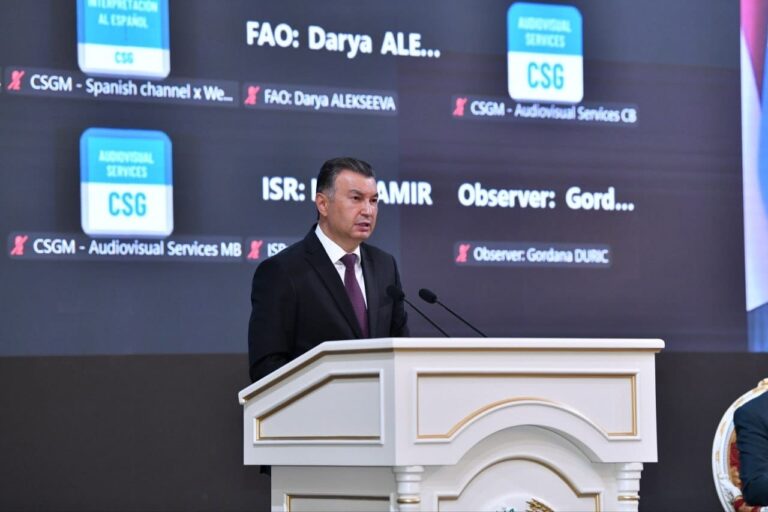
“The oil and gas exporters benefited from high oil prices. Also, the others benefited from the fact that while there was a slow down in Europe, Russia with which they are very connected, particularly in terms of remittances, continued to do relatively well and consequently, for example, remittances to these countries increased by about 20 percent last year and likely to increase again by about 13 percent this year. This is particularly important for countries like Tajikistan where remittances account, actually, for almost a third of GDP. It’s really a very high number in relations to most countries across,” Masood Ahmed, Director of International Monetary Fund Middle East and Central Asia Department told a news conference during the IMF and World Bank annual spring meetings in Washington.
According to the IMF, total remittance inflows to oil and gas importers are forecast to expand by 12.7 percent in 2012 compared with 20.2 percent in 2011.
The IMF classifies Tajikistan and Kyrgyzstan as “oil and gas importers” with Kazakhstan, Turkmenistan and Uzbekistan classified as “oil and gas exporters.”
According to the IMF, growth in Kazakhstan is seen at 5.9 percent this year and 6 percent the following year. In Kyrgyzstan, growth is projected at 5 percent in 2012 and 5.5 in 2013.
Forecast for Tajikistan is 6 percent and 6 percent, for Turkmenistan is 7 percent and 6.7 percent, and for Uzbekistan is 7 percent and 6.5 percent, respectively.
“As a group, I think it’s fair to say that this group of countries continued to have quite robust economic performance in 2011 and as a group they recorded a growth rate of close to 7 percent which is good in any year but certainly last year when the world economy was going through a difficult period. It’s a good number for any set of countries to have,” Ahmed said.
He also said the IMF urged countries of Central Asia to use their strong growth to advance market reforms.
“In a few countries, there are problems also of impaired banking sectors. So there are problems in the financial sector in Kazakhstan, the Kyrgyz Republic, in Tajikistan which could be a source of macroeconomic risk down the road and it’s important to address these banking sector problems. So our basic policy message, to this set of countries is that since you are doing relatively well now in terms of the macroeconomic and financial picture it’s a very good time to build buffers and to address some of theses underlaying and in some cases long standing sources of vulnerability,” Ahmed said.