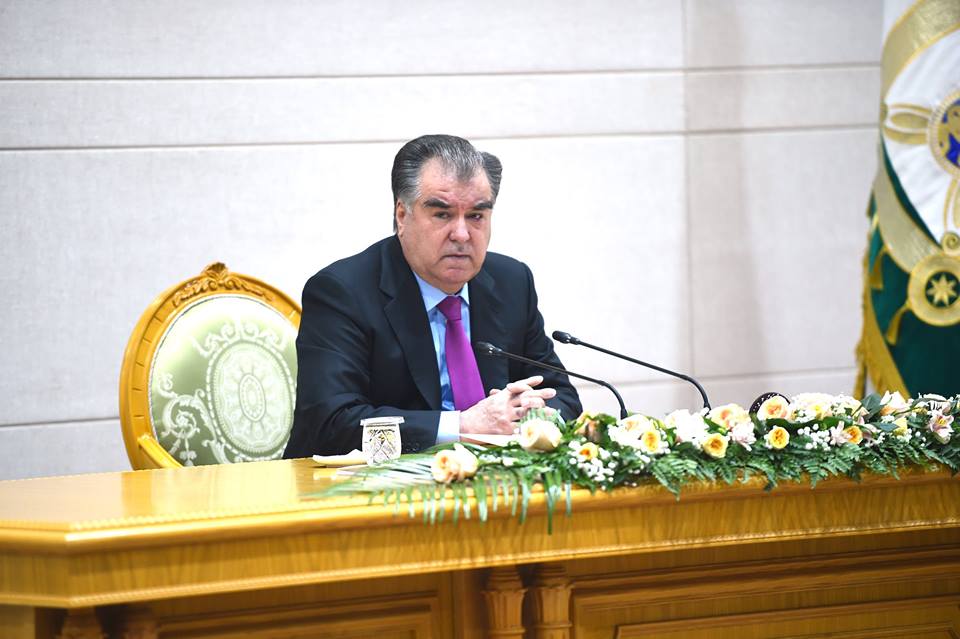
In statement delivered at the inaugural ceremony of the International High-Level Conference on the International Decade for Action “Water for Sustainable Development, 2018-2028,” President Emomali Rahmon on June 20 pointed to the necessity of developing effective practical steps to implement the internationally agreed goals and objectives in the field of water resources.
He expressed confidence that the conference will provide an opportunity to prepare concrete recommendations on the topic of the forthcoming meeting of the High-Level Political Forum on Sustainable Development, where the SDG 6 will be discussed.
“We are embarking on the promotion of the new Decade with a very useful experience in the implementation of previous global water initiatives, Tajik leader said.
At the same time, he noted that more than 800 million and 2.5 billion of the world's population, respectively, do not have access to safe drinking water and basic services in the field of water sanitation and up to 300,000 children under the age of five die annually due to lack of access to safe drinking water and sanitation.
“All this indicates that we are still considerably behind in the practical implementation of the set goals and objectives in the field of ensuring access to safe drinking water and sanitation,” Rahmon said, noting that in addition, the situation in achieving sustainable water management is complicated by the negative impact of climate change.
He said that more than two billion people in the world today experience water stress and this figure can grow to five billion by 2050.
Two factors – global climate change and demographic growth — will determine the scope and opportunities for further actions, Tajik leader said, noting that along with those factors, there are a number of other tasks that require an integrated approach and active water cooperation.
These include issues of increasing the overall efficiency of water use, reducing water pollution and re-use, and developing new technologies for obtaining fresh water on an industrial scale.
Rahmon proposed to convene every two years International High-Level Conference on the implementation of the goals and objectives of the Decade.
“In this direction, we will continue our cooperation with interested countries and organizations within the framework of the International Steering Committee,” said Rahmon. “…We also intend to strengthen work in this direction by creating an International Center for the Implementation of the Decade in Dushanbe.”
According to the calculations of the World Bank, only to achieve the two objectives of the 6th Goal of Sustainable Development, namely, universal access to safe drinking water and sanitation, will amount to 114 billion US dollars annually.
“In this regard, efforts should be focused on increasing the efficiency of using available financial resources and finding new sources of financing for water-related industries,” Rahmon said, noting that the expansion of public-private partnership opens new opportunities for attracting additional investments in the water sector and infrastructure.
Tajik leader noted that transboundary component of water cooperation is also an important issue.
“Effective, fair and mutually beneficial water cooperation can become a catalyst for the development of countries connected by common water basins,” said Tajik leader. “The Central Asian region, which is characterized by uneven formation of water resources, is a clear example of constructive water cooperation.”
Rahmon noted that long-term observations indicated an increase in the impact of climate change on nature and the socio-economic situation in Tajikistan and Central Asia.
According to these observations, over the past sixty years the average annual air temperature in Tajikistan has increased by one degree Celsius.
Under the influence of these factors in Tajikistan, natural disasters in the form of inundation, floods, mudflows, avalanches and landslides annually cause serious damage to the population and economy of the country.
“In addition, over the past few decades, we have lost nearly 1,000 small and medium glaciers” said Rahmon. “In order to monitor these processes and take measures to adapt to climate change factors, we have established the Glacier Research Center at the Academy of Sciences of Tajikistan this year and look forward to the support of our development partners in strengthening its capacity.”