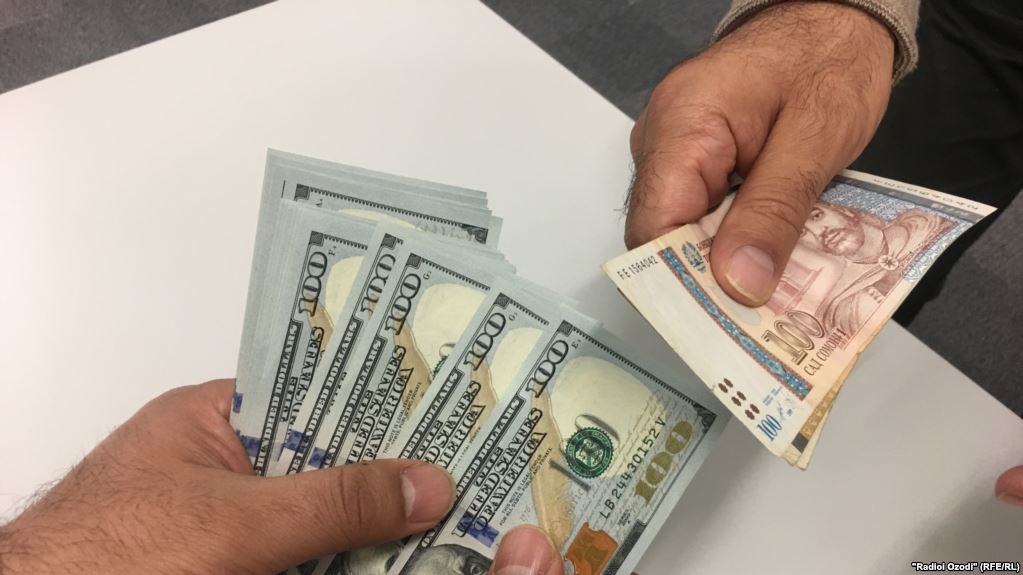
Tajikistan has seen sharp currency devaluation in recent days. The national currency, the somoni (TJS), has fallen 2.7 percent against the dollar (USD) in two days.
The value of the somoni has continued to depreciate against the U.S. dollar, registering an average market purchase rate of the dollar against the somoni 1:9.43 on July 11, up from 1:918 on July 10.
An official exchange rate of the dollar set by the National Bank of Tajikistan (NBT) for July 11 is 1:9.17.
Tajik central bank attributes the rise in the USD exchange rate to, first of all, the negative balance of the country’s external trade turnover.
According to data from Tajik central banks, the official exchange rate of the dollar against the somoni has risen 3.8 percent over the first six months of this year: 0.9 percent increase in April; 1.3 percent increase in May; and 1.6 percent increase in June.
Meanwhile, the market purchase rate of the dollar against the somoni has reportedly risen 4.5 percent over the same six-month period. Over the same period last year, the market purchase rate of the dollar against the somoni had risen 11.7 percent.
The National Bank now reportedly adheres to the forex policy based on “the floating regulated exchange rate without determination of limits of change in exchange rate.”
Recall, a working meeting to review issues related to measures to ensure the country’s forex market stability was held on July 3. The meeting participants included top managers of the NBT Department for International Reserves and Forex Policy and senior representatives of local lending agencies.
Speaking at the meeting, the head of the NBT Department for International Reserves and Forex Policy, Olim Qayumov, in particular, stressed that a certain stability of the national currency, the somoni, against the foreign currencies had been achieved due to monetary policy carried out by Tajik central bank.
Representatives of Tajik central bank say that the current situation in the country’s forex market is more stable compared to the previous years.
Tajikistan has mainly resorted to “administrative resources” to keep the currency on an even keel.
In December 2015, the National Bank ordered the closure of all unauthorized currency exchange points in the city. After that, only banks were able to perform foreign exchange operations. Anybody found violating this new arrangement could face jail terms of up to nine years. Also, banks are forbidden by law from selling somoni at more than 1.5 percent the rate established by the National Bank.
Even the Finance Ministry has long freely admitted the somoni is set for gradual devaluation, which explains why people are so eager to get rid of their stocks. According to the ministry’s forecasts, the somoni is projected to slide to 10.4 somoni in 2018 and to 11.2 somoni in 2019