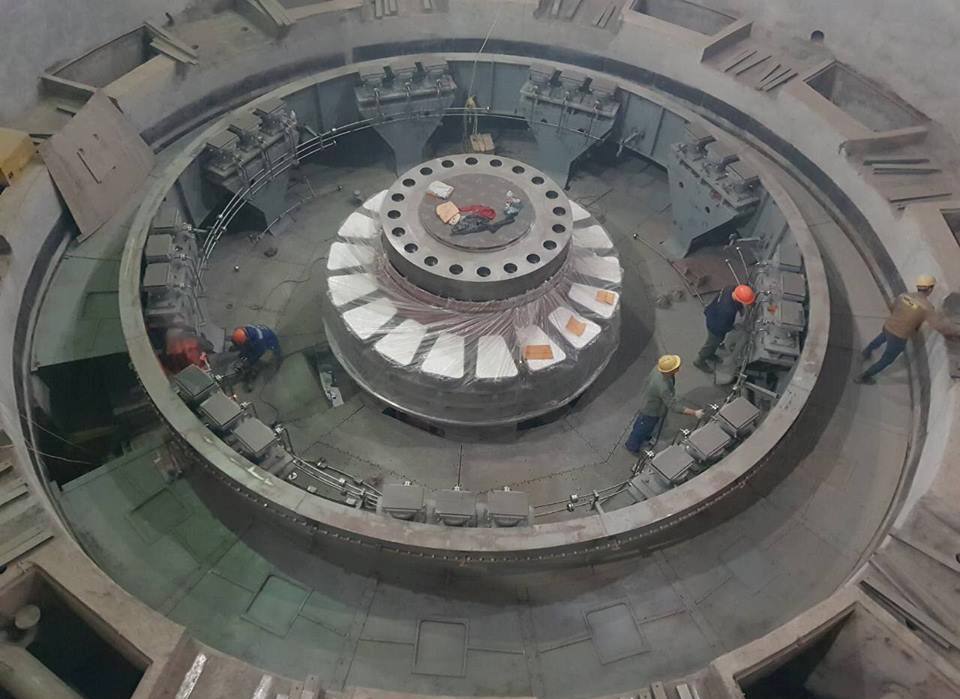
The first unit of the Roghun hydroelectric power plant (HPP) that was introduced into operation on November 16 last year now generates up to 3.9 million kWh of electricity per day, Mirzo Ismoilzoda, the head of Barqi Tojik (Tajik power utility company), told reporters in Dushanbe on July 31.
Since November 16, the power plant has generated 210.5 million kWh of electricity, Ismoilzoda noted.
Barqi Tojik top managers had earlier noted that Roghun’s first unit had produced 33 million kilowatt hours of electricity during its first 45 days (from November 16 to December 31).
Recall, Tajikistan stemmed the flow of the Vakhsh River for construction of the Roghun HPP in late October 2016.
Roghun HPP is an embankment dam in the preliminary stages of construction on the Vakhsh River in southern Tajikistan. It is one of the planned hydroelectric power plants of Vakhsh Cascade.
The Roghun HPP was first proposed in 1959 and a technical scheme was developed by 1965. Construction began in 1976 but the project was frozen after the collapse of the Soviet Union.
An agreement on finishing the construction was signed between Tajikistan and Russia in 1994; however, as the agreement was not implemented, it was denounced by Tajikistan parliament.
In October 2004, Tajikistan signed an agreement with Russia's RusAl aluminum company, according to which RusAl agreed to complete the Roghun facility and rebuild the Tursunzoda aluminum smelter. In August 2007, Tajikistan formally revoked a contract with RusAl, accusing it of failing to fulfill the contract.
In April 2008, Tajikistan founded OJSC NBO Roghun with an authorized capital of 116 million somoni for completing the construction of the Roghun HPP. Current authorized capital of OJSC NBO Roghun reportedly amounts to 27.76 billion somoni (equivalent to some 3 billion U.S. dollars).
To raise funds to complete construction of the Roghun HPP the government started to sell shares in Roghun to people on January 6, 2010. Tajikistan has reportedly issued 6 billion somoni worth of Roghun shares. The sale of Roghun shares has reportedly earned the government 980 million somoni.
Tajikistan issued its first Eurobond in 2017 to help finance the project, which will include the world’s tallest dame when it is completed in 2026.
Italy’s Salini Impregilo won a $3.9 billion contract, making it the biggest single investment in Tajikistan since it gained independence in 1991.
The Roghun HPP’s first of six units was officially switched on November 16, 2016. But output at the unit was temporarily suspended in early March this year because of maintenance work.
The second unit of the Roghun HPP is expected to be introduced into operation in September this year.
Once it is completed — by 2033, if all goes to plan — Roghun should comprise a total of six 600-megawatt generating units. At peak annual capacity, the plant should be able to produce up to 17 billion kilowatt hours of electricity.
The government hopes the Roghun hydropower plant will help end power rationing in winter months while also allowing Tajikistan to boost energy exports to its neighbors, such as Uzbekistan and Afghanistan.