Civil society in Uzbekistan hindered in ability to contain COVID-19 corruption

Shortly after Uzbekistan began battling to contain its coronavirus outbreak, it successfully solicited aid from international financial institutions, but there are concerns some of that money is now being stolen, according to Eurasianet. Speaking last week, the chair of the Senate, Tanzila Narbayeva, reportedly said the anti-corruption agency had discovered that more than US$171,000 have […]

Asia-Plus

Shortly after Uzbekistan began battling to contain its coronavirus outbreak, it successfully solicited aid from international financial institutions, but there are concerns some of that money is now being stolen, according to Eurasianet.

Speaking last week, the chair of the Senate, Tanzila Narbayeva, reportedly said the anti-corruption agency had discovered that more than US$171,000 have been embezzled by employees with the sanitary-epidemiological service, a department within the Health Ministry, since the start of the COVID-19 crisis.

The theft is alleged to have targeted the government’s US$1 billion coronavirus anti-crisis fund, which was set up in March.  That money was allocated, among other things, for setting up medical centers and quarantine facilities, as well as to support certain in-need areas of the economy.

The authorities are reportedly intent to show they are acting as frustrations mount over suspected corruption.  But the reaction of the security services to people voicing criticism is undermining the government’s credibility on that front.

Over six months, Uzbekistan has reportedly received more than US$1 billion in credit for its battle against COVID-19. The main donors are the Asian Development Bank (ADB) with US$600 million, the International Monetary Fund (IMF) with US$375 million, and the World Bank (WB) with US$200 million.

On June 9, Miraziz Bazarov, an employee of a Tashkent-based consulting company, posted an open letter to the IMF and ADB on his Facebook page in which he expressed his worries about the sudden flood of financial aid.  In his message, Bazarov urged the institutions to refrain from issuing loans to Uzbekistan until the government devises a mechanism for the public to keep tabs on how funds are spent.

His appeal provoked much discussion on social media, much of it in support of his position.  The security services were paying attention too.  On July 27, Bazarov was summoned to the State Security Service, or SGB, for questioning.

Bazarov arrived at SGB headquarters with his lawyer, Sergei Mayorov, prompting the security services to deny them both access.

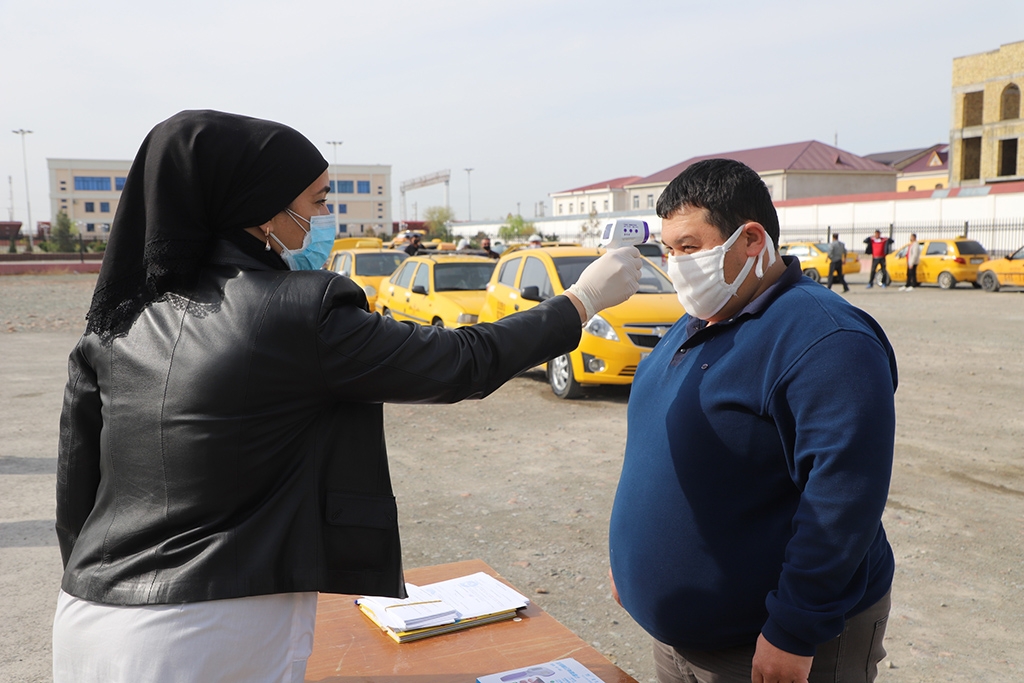
“I sat at the entryway to the SGB for more than an hour with my lawyer Sergei Mayorov and they would not let us in. To begin with, they did not want to let in my lawyer, although this is illegal.  After an hour, they began to check our temperature, and Mayorov supposedly was at 37 degrees [Celsius] … and so apparently according to lockdown rules he could not be allowed inside,” Bazarov wrote, according to Eurasianet.

Join us on social media!

Article translations:

Related Article

Оби зулол
Оби зулол

Most Read

Акика Алиф

Recent Articles

In Tajikistan, a unique surgery was performed for the first time on a child with an extremely rare pathology

Tajik and Russian surgeons successfully performed the most complex reconstruction of the bladder and abdominal wall for a child with recurrent exstrophy.

The ministry of health states that hantavirus does not threaten Tajikistan

Cases of infection with this virus were detected on board the cruise liner Hondius near the Canary Islands.

Tajikistan lags behind other Central Asian countries in number of chain hotels – study

The Republic remains a niche market with a limited number of quality hotels.

Climate risks threaten food security in Central Asia – FAO

Land degradation reduces agricultural productivity. The loss of biodiversity weakens the ecosystems that farmers, livestock breeders, and rural communities depend on.

Potential or illusion? Why the world overlooks Tajikistan’s mineral wealth

The republic may indeed possess significant reserves of rare metals, but there is a catch...

The case of ousted Kyrgyz security boss classified and moves to court

The former head of the GKNB is charged with violent seizure of power and abuse of official position.

Trump states that Iran’s nuclear program is a higher priority than U.S. citizens’ economic issues

Fluctuations in energy prices led to record inflation in the United States in April, the highest in the past three years.

Foot-and-mouth disease, plague, and flu: Central Asia threatened by transboundary animal diseases

FAO urges Central Asian countries to strengthen coordination and epidemiological surveillance.

Tajikistan approves the second phase of the Electric Transport Development Program; $95 million will be allocated for its implementation.

At this stage, the authorities are focusing on charging infrastructure, services for electric vehicles, and the expansion of the electric bus fleet.

Tajikistan and Kazakhstan to sign roadmap for cooperation in the agrarian sector

The parties are interested in expanding investment cooperation and establishing joint ventures.