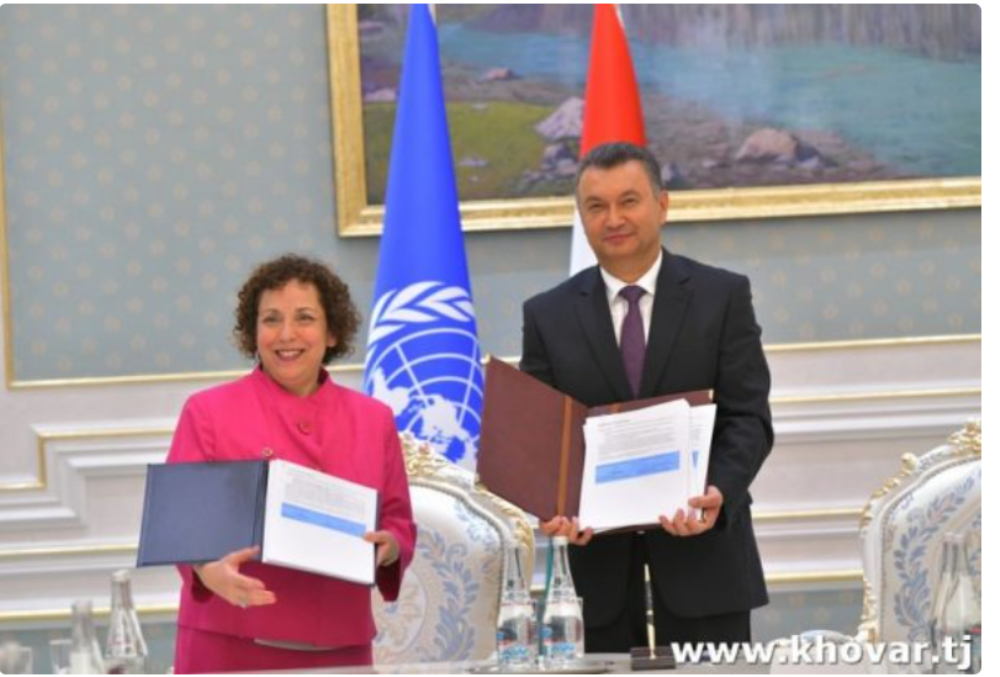
The Government of Tajikistan and the United Nations have signed the Sustainable Development Cooperation Framework designed for 2023-2026.
The document was inked here on June 7 by Tajik Prime Minister Qohir Rasoulzoda and UN Resident Coordinator Ms. Sezin Sinanoglu.
The document was signed following the meeting of Tajik Prime Minister Qohir Rasoulzoda with Ms. Amina J. Mohammed, the Deputy Secretary-General of the United Nations and Chair of the United Nations Sustainable Development Group.
The UN Sustainable Development Cooperation Framework represents a joint commitment to work together and with country partners for the achievement of Tajikistan priorities and the sustainable development agenda.
This Sustainable Development Cooperation Framework (CF) between the Government of Tajikistan and the United Nations (UN) is anchored by country strategic priorities: The National Development Strategy and Mid-term Development Program, the Sustainable Development Goals (SDGs) and nationalized targets, the human rights commitments of Tajikistan and effective response and recovery from the COVID-19 pandemic.
The national development vision calls for: ‘A steadily growing, competitive country that provides decent living standards and equal opportunities for each person to realize his or her potential based on equality, justice and respect for human dignity’. With the NDS 2030, Tajikistan has made tangible progress toward achievement of the SDGs. While poverty rates have fallen, the Tajikistan VNR highlights that 1 in 4 persons is vulnerable to multi-dimensional poverty.
To respond, the CF is focused on reaching vulnerable groups to ensure they are not left behind. CF results will be achieved in broad partnership with civil society organizations (CSOs) and volunteer groups, non-governmental organizations (NGOs), the human rights institutions, academia, media, the private sector, and international partners. The Government of Tajikistan and the UN system have mutual accountability for the achievement of CF results.
There are three strategic priorities for cooperation (inclusive human; shared, resilient prosperity and sustainable, climate-responsive development; and people-centered governance and rule of law) and four expected outcomes: 1) inclusive human development; 2) sustainable, inclusive, and green economic growth; 3) integrated management of climate and environmental risk; and 4) people-centered governance and rule of law.
Cooperation aims to achieve a set of inter-connected and measurable changes at both institutional and community levels. These will support Tajikistan to secure improved living standards based upon sustainable economic development and equal opportunities for each person to realize his or her potential based on equality, justice and respect for human dignity.