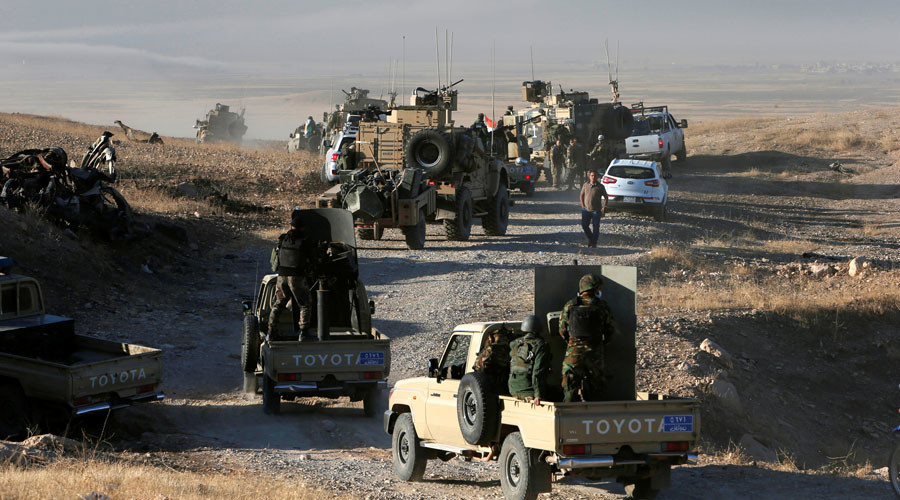
Residents of Mosul said militants of the Islamic State terrorist group were using civilians as human shields as Iraqi and Kurdish forces captured outlying villages in their advance on the jihadists' stronghold, Reuters reported today morning.
The leader of Islamic State was reported to be among thousands of hardline militants still in the city, suggesting the group would go to great lengths to repel the coalition.
With attacking forces still between 20 and 50 kilometers away, residents reached by telephone said more than 100 families had started moving from southern and eastern suburbs most exposed to the offensive to more central parts of the city.
Islamic State militants were preventing people fleeing Mosul, they said, and one said they directed some towards buildings they had recently used themselves.
The fall of Mosul would signal the defeat of the ultra-hardline Sunni jihadists in Iraq but could also lead to land grabs and sectarian bloodletting between groups which fought one another after the 2003 overthrow of Saddam Hussein, according to Reuters.
In Washington, Pentagon spokesman Captain Jeff Davis told reporters that it was known that civilians were being used as human shields.
Iraqi Prime Minister Haider al-Abadi said safe routes had been secured for civilians who wanted to leave Mosul and it was the duty of the U.S.-led coalition to prevent Islamic State fighters from escaping into nearby Syria.
More than 5,000 U.S. soldiers are also deployed in support missions, as are troops from France, Britain, Canada and other Western nations.
The Syrian army, meanwhile, accused the coalition of planning to allow Islamic State militants to flee across the border.
If Islamic State fighters are allowed to leave Mosul and go to Syria, Russia would take the appropriate military and political decisions, the Russian foreign minister warned, according to Russian RT news agency.
Commenting the ongoing siege of the Iraqi city, Sergey Lavrov said on Tuesday: “As far as I know, the city is not fully encircled. I hope it’s because they simply couldn’t do it, not because they wouldn’t do it. But this corridor poses a risk that Islamic State fighters could flee from Mosul and go to Syria.
“We will be evaluating the situation and take decisions of both political and military nature if this happens,” he added. “I hope the US-led coalition, which is actively engaged in the operation to take Mosul, will take it into account.”
Meanwhile, the United Nations has said up to a million people could flee the city and that it expected the first big wave in five or six days, indicating fighting would reach the city then.