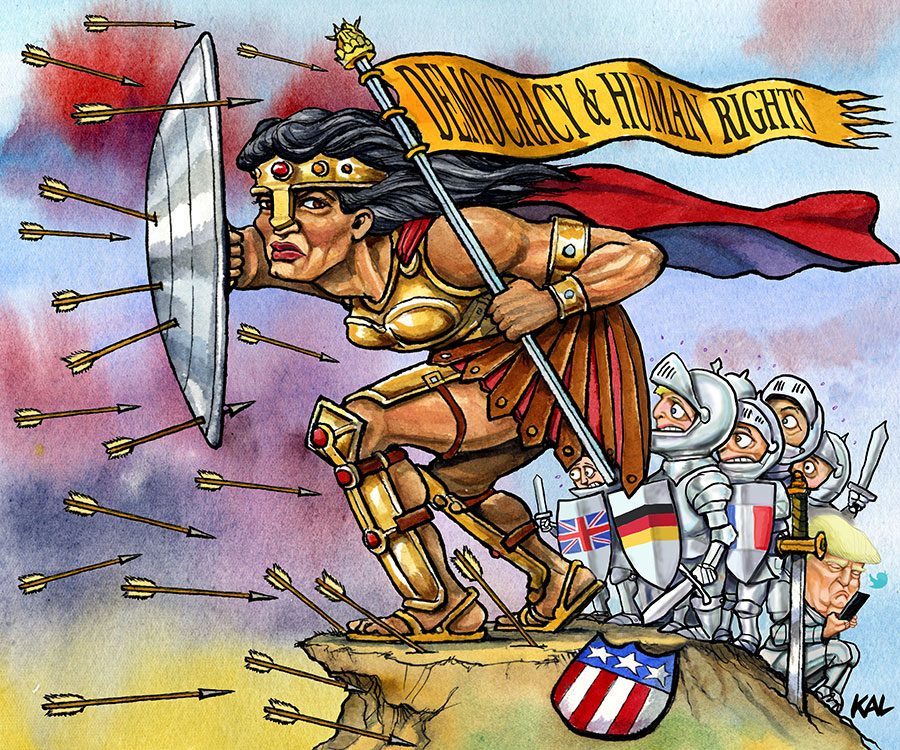
The latest edition of Freedom in the World, the annual report compiled by U.S.-based rights watchdog Freedom House, has listed Tajikistan among Not Free societies again.
The Freedom House report, Freedom in the World 2018: Democracy in Crisis, evaluates the civil rights and political liberties of 195 countries during 2017.
The findings for Freedom in the World 2018, which were released yesterday reflect a complex picture for the state of global freedom.
The report notes that democracy is under assault and in retreat around the globe.
The report finds that 2017 was the 12th consecutive year of decline in global freedom. Seventy-one countries suffered net declines in political rights and civil liberties in 2017, with only 35 registering gains.
“Democracy is facing its most serious crisis in decades,” said Michael J. Abramowitz, president of Freedom House. “Democracy’s basic tenets—including guarantees of free and fair elections, the rights of minorities, freedom of the press, and the rule of law—are under siege around the world.”
Freedom in the World 2018 reports on how China and Russia have taken advantage of the retreat of leading democracies both to increase repression at home and to export their malign influence to other countries. To maintain power, these autocratic regimes are acting beyond their borders to squelch open debate, pursue dissidents, and compromise rules-based institutions.
According to the report, a major development of 2017 was the retreat of the United States as both a champion and an exemplar of democracy. While Freedom House has tracked a slow decline in political rights and civil liberties in the United States for the past seven years, the decline accelerated in 2017, owing to growing evidence of Russian interference in the 2016 elections, violations of basic ethical standards by the new administration, and a reduction in government transparency.
“The Trump administration has made a sharp break from the political consensus of the last 70 years by casting aside democracy as the animating force behind American foreign policy,” Mr. Abramowitz said. “The hastening withdrawal of the United States from its historical commitment to supporting democracy overseas makes the challenge posed by authoritarian regimes all the more powerful and threatening.”
Over the period since the 12-year slide began in 2006, 113 countries have seen a net decline, and only 62 have experienced a net improvement.
Of the 195 countries assessed, 88 (45 percent) were rated Free, 58 (30 percent) Partly Free, and 49 (25 percent) Not Free.
Of the 49 countries designated as Not Free, the following 12 have the worst aggregate scores for political rights and civil liberties, earning less than 10 points on a 100-point scale (beginning with the least free): Syria, South Sudan, Eritrea, North Korea, Turkmenistan, Equatorial Guinea, Saudi Arabia, Somalia, Uzbekistan, Sudan, Central African Republic, and Libya.
At the same time, Freedom House lists Uzbekistan among the countries that may experience important developments in the coming year, and deserve special scrutiny. Surrounded by neighbors with entrenched dictators, Uzbekistan prompted cautious optimism as its new administration—formed after the death of longtime autocrat Islam Karimov—ended some forms of forced labor and granted new if limited space for civil society, the report said.
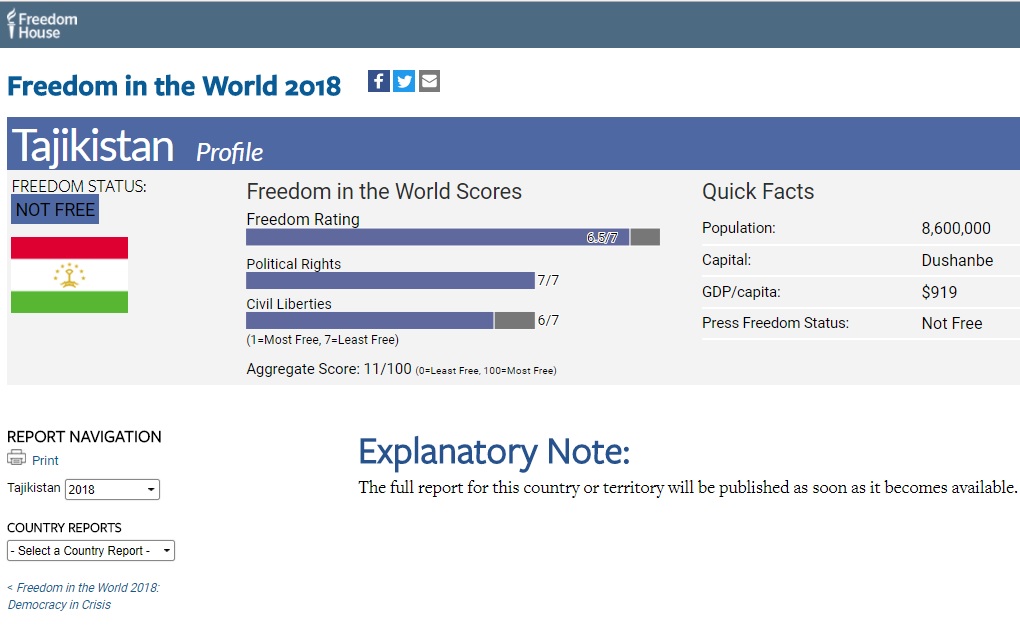
Tajikistan with 11 points on a 100-point scale is listed among Not Free societies.
Meanwhile, Kyrgyzstan is the only partly free country in Central Asia.
Freedom House is an independent watchdog organization that supports democratic change, monitors the status of freedom around the world, and advocates for democracy and human rights.