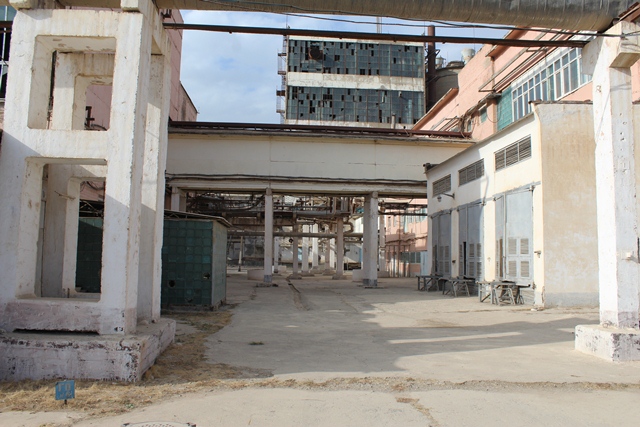
The government is reportedly expected to pay off Tajik fertilizer plant’s wage debts. TojikAzot’s wage debts now amount to 2.5 million somoni.
“These debts had accrued before the enterprise was transformed into joint venture,” a source in the Khatlon regional administration told Asia-Plus in an interview.
According to him, this amount is nearly the half of Khatlon’s wage debts.
“As of December 1, 2017, the province’s wage debts amounted to 4.8 million somoni, with some 71 percent of them being debts of industrial enterprises,” the source added.
Recall, Open Joint-Stock Company (OJSC) Nurihoi Osiyo (Fertilizers of Asia) with an authorized capital of 720 million USD was established on established on the basis of TojikAzot in November 2016.
China’s Henan Zhongya Holding Group owns 50%+1 shares of the enterprise for the first ten years and then transfers this package of shares to Tajikistan.
Tajikistan’s current annual requirements in urea are 360,000 tons and Tajikistan is reportedly forced to pay 50 million USD every year to meet its requirements in urea.
The enterprise produces urea, ammonia, carbon dioxide, oxygen and liquid nitrogen.
The plant reportedly also has service shop for power supply and repairing mechanical, electrical and measuring equipment.
About 1,000 people now work for the plant and its products are expected to be exported to Afghanistan, Iran, Turkmenistan, Ukraine, Hungary, Poland, Slovakia and Romania.
The debt-ridden and loss-making fertilizer plant, TojikAzot, had not been in operation since 2008 due to lack of natural gas supplies.
Until 2008, when neighboring Uzbekistan upped the price of natural gas, a key input for the factory, TojikAzot served as a foreign investment-success story for Tajikistan’s economy.
TojikAzot was partly state owned, with the government controlling a 20 percent stake in the troubled enterprise. Ostark Ventures Limited (Ukrainian oligarch Dmitry Firtash is beneficial owner of Ostark Ventures Limited) assumed the 75% ownership interest in the enterprise and Khairullo Saidov, the son of ex-Minister of Industry Zayd Saidov, owned 5 percent of shares in TojikAzot.
On June 24, 2014, the Khatlon Economic Court invalidated the transaction for the sale of TojikAzot.
Tajikistan’s Agency for State Financial Control and Combating Corruption in March 2014 announced an investigation into a 2002 deal between Dmitry Firtash and the Tajik government to create TojikAzot, a plant specializing in the production of urea, an organic compound used in fertilizer. The anticorruption agency accused Firtash of illegal privatization of the company in 2002 and misappropriation of funds.
Firtash was arrested in Vienna on March 12, 2014, and released on a 125 million Euro bail two days later.
Following Firtash’s arrest, Tajikistan’s anticorruption agency charged him on March 15 with the illegal privatization of the clothing factory Guliston in 2002.
The anticorruption agency argued that Zayd Saidov had been involved in the fraudulent privatization of Guliston and TojikAzot.