The work on implementation of the Roghun hydropower project is being carried out in accordance with schedule, Tajik Minister of Energy and Water Resources Usmonali Usmonzoda told reporters in Dushanbe on January 30.
According to him, the first unit of the Roghun hydroelectric power plant (HPP) will be introduced into operation this year.
“There are some problems but we believe the project will be implemented in time,” the minister said, noting to that contractors committed themselves to introduce the first unit of the plant in time.
Recall, Tajikistan stemmed the flow of the Vakhsh River for construction of the Roghun hydroelectric power plant (HPP) mega-dam in late October 2016. Explosions were used on October 29, 2016 to block the main riverbed of the Vakhsh River, marking the first substantial step toward building the dam. The work on the Vakhsh River has not affected existing hydroelectric facilities downstream.
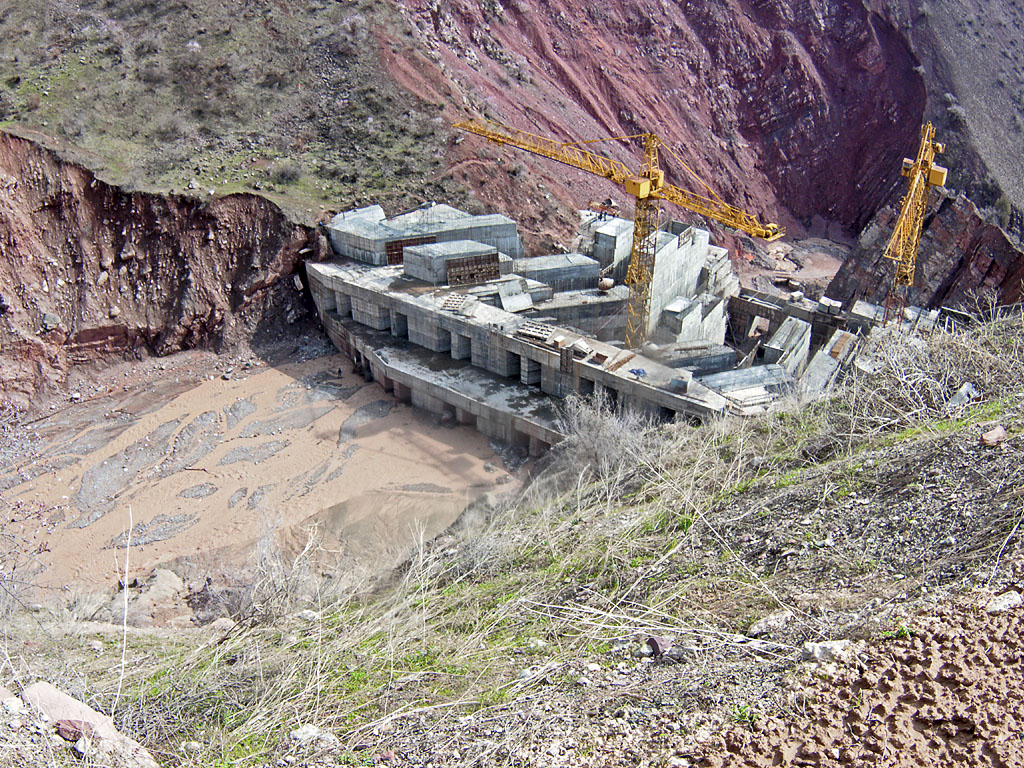
Roghun HPP is an embankment dam in the preliminary stages of construction on the Vakhsh River in southern Tajikistan. It is one of the planned hydroelectric power plants of Vakhsh Cascade.
The Roghun HPP was first proposed in 1959 and a technical scheme was developed by 1965. Construction began in 1976 but the project was frozen after the collapse of the Soviet Union.
An agreement on finishing the construction was signed between Tajikistan and Russia in 1994; however, as the agreement was not implemented, it was denounced by Tajikistan parliament.
In October 2004, Tajikistan signed an agreement with Russia's RusAl aluminum company, according to which RusAl agreed to complete the Roghun facility and rebuild the Tursunzoda aluminum smelter. In August 2007, Tajikistan formally revoked a contract with RusAl, accusing it of failing to fulfill the contract.
In April 2008, Tajikistan founded OJSC NBO Roghun with an authorized capital of 116 million somoni for completing the construction of the Roghun HPP. Current authorized capital of OJSC NBO Roghun reportedly amounts to more than 12 billion somoni.
To raise funds to complete construction of the Roghun HPP the government started to sell shares in Roghun to people on January 6, 2010. Tajikistan has reportedly issued 6 billion somoni worth of Roghun shares. To-date, the sale of Roghun shares has reportedly earned the government 830 million somoni.
In response to the request of the bordering countries and especially Uzbekistan, the World Bank has financed the Techno-Economic Assessment Study (TEAS) conducted by consortium of Coyne et Bellier, Electroconsult and IPA Energy + Water Economics, and Environmental and Social Impact Assessment (ESIA) conducted by Poyry. The ESIA was published on June 16, 2014 and the TEAS in July 2014. Overall, the ESIA stated that “Most impacts are rather small and easily mitigated, if mitigation is required at all.” and that “There is no impact of the category “strong negative, mitigation not possible,” which would have to be considered as a no-go for the project.”
In 2016, construction duties on Roghun were assigned to Italian company Salini Impregilo. It is estimated that the project will cost $3.9 billion to complete.
The project is broken down into four components, with the most expensive one involving the building of a 335-meter-high rockfill dam — the tallest in the world — which will entail costs of around $1.95 billion.
According to Salini Impregilo, two of the six turbines will start producing energy for sale this year to raise funding to complete it. The first turbine is expected to go into service in August 2018, followed by the second one in October of the same year.
If built as planned, the dam will be the tallest in the world at 335 meters and have a capacity of 3600 MW.
In 2017, 4.7 billion somoni were spent for construction of the Roghun HPP.
This year, the Tajik authorities reportedly plan to spend nearly 5 billion somoni for construction of the Roghun HPP.