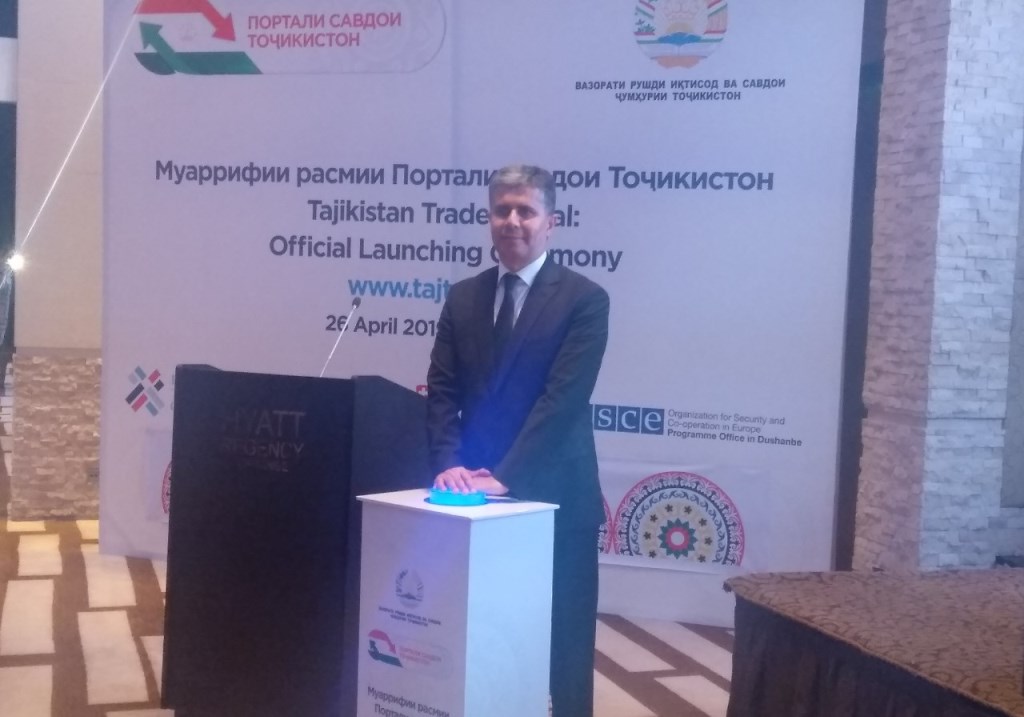
The Swiss Government, the International Trade Center (ITC) and the United Nations Conference on Trade and Development (UNCTAD) have supported Tajikistan in developing and operationalizing “Tajikistan Trade Portal” – www.tajtrade.tj. The Tajikistan Trade Portal was officially presented at a ceremony in Dushanbe on April 26.
The event was organized by the Ministry of Economy Development and Trade of Tajikistan and the International Trade Center under financial support of the Government of Switzerland and other development partners, namely the UNCTAD, the Organization for Security and Cooperation in Europe (OSCE), and the United Nations Development Programme (UNDP).
According to ITC Tajikistan, the Trade Facilitation Portal is an online platform that provides step-by-step description of import and export procedures from the trader’s point of view. It displays, in a user-friendly manner, all the documents and form (i.e. license, permits, and certificates) that businesses must submit and/or collect from each border regulatory agencies and highlights the fees and charges that traders will be required to pay.
The Portal introduction is continuance of Tajikistan Government efforts on streamlining and simplifying trade processes for the benefit of Tajikistan’s business community.
Mr. Zavqi Zavqizoda, First Deputy Minister of the Economic Development and Trade of Tajikistan, addressing the Tajik business community, officials, diplomatic missions, and international partners, at the portal launch ceremony, said: “The Tajikistan Trade Portal is the first experience and the tool in the country’s foreign trade activity. It provides domestic, foreign entrepreneurs and other stakeholders an opportunity to receive information on procedures and documentation for export and import of goods, reducing entrepreneurs’ time and costs”.
ITC in partnership with UNCTAD has been providing technical support to establish the portal and build national capacity to operate it effectively. In one year and a half, 39 product specific export and import procedures, which include 1500 goods and products were documented and continuously updated on the portal under ITC and UNCTAD guidance. These procedures were also certified by border regulatory agencies in order to validate that displayed information is correct and traders can benefit from it. In order to keep the portal fully operational over time, ITC and MEDT have agreed on governance structure of the portal and are organizing trainings on portal operationalization to ensure sustainability of the platform in the future.
Ms. Alina Fetisova, International consultant on Trade Facilitation at ITC, Geneva says: “As a next step, ITC would like to explore possibilities to assist the Republic of Tajikistan in leveraging information in the portal to design simplification reforms”.
The trade facilitation portal is a key tool for transparency that benefits businesses as well as Tajikistan government. For traders, it gives a detailed picture of what needs to be done to comply with national regulations. It thus reduces the time and cost invested by traders to obtain and analyze trade related information and minimize the risk of shipment being delayed at the border due to non-compliance with import/export requirements. For government agencies, it helps with the identification of all unnecessary redundancies and administrative bottlenecks. The TF Portal will thus assist the Government of Tajikistan, through the Coordinating Committee on Trade Facilitation (CCTF), to streamline and simplify trade processes for the benefit of Tajikistan’s business community and to ensure compliance with WTO TFA (Art. 1.2).
The International Trade Center, supported by the Government of Switzerland, aims to increase the export competitiveness of the Tajik T&C sector by supporting sector companies and relevant trade support institutions from both public and private sectors.