A new report released by Standard and Poor (S&P) Global Ratings, an American credit rating agency (CRA) and a division of S&P Global, notes that rice in international prices will increase risks for emerging markets, including Tajikistan and Uzbekistan.
The report, in particular, says the low and middle income countries in Central Asia, Middle East Africa and the Caucasus, food markets are hardest hit by turmoil in food markets.
Tajikistan and Uzbekistan are highly dependent on food imports and usually buy the bulk of their wheat from Kazakhstan, which limited wheat and flour exports to 1 million tons and 300,000 tons, respectively, for three months starting on April 15.
S&P Global Ratings notes that price hike can damage public finances and increase discontent among the population.
According to the report, the Russian-Ukrainian conflict has caused a serious damage to the global food chain. Ukraine is one of world’s leading exporters of wheat and other cereals as well as sunflower oil. As a result of the conflict, the flow of agricultural products from this country has been blocked and food prices have risen.
The report notes that the food product imports to the gross domestic product (GDP) ratio has neared 3.5 percent, which is the highest rate in the world.
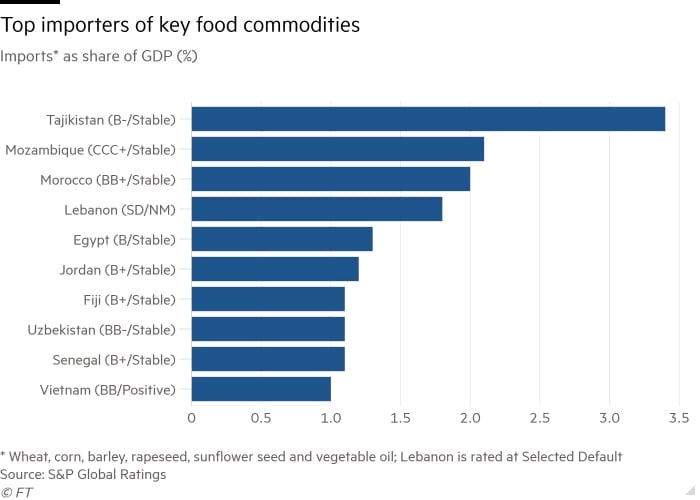
In Uzbekistan, the food products import to GDP ratio has been more than 1.0 percent.
Meanwhile, S&P Global forecasts that the food crisis can last until 2024.
It is to be noted that over the past five years, about 40 percent of import financing in Tajikistan has been spent for purchase of food products. Wheat and flour occupy leading positions in Tajikistan’s imports. The shares of vegetable oil and sugar are reportedly also quite large in the country’s imports.
S&P Global Ratings (S&P) is an American credit rating agency (CRA) and a division of S&P Global that publishes financial research and analysis on stocks, bonds, and commodities. S&P is considered the largest of the Big Three credit-rating agencies, which also include Moody's Investors Service and Fitch Ratings.
As a credit rating agency (CRA), the company issues credit ratings for the debt of public and private companies, and other public borrowers such as governments and governmental entities. It is one of several CRAs that have been designated a nationally recognized statistical rating organization by the U.S. Securities and Exchange Commission.